West Yorkshire Writes: Benjamin Myers and curing powers of the valley – interview
November 12, 2026
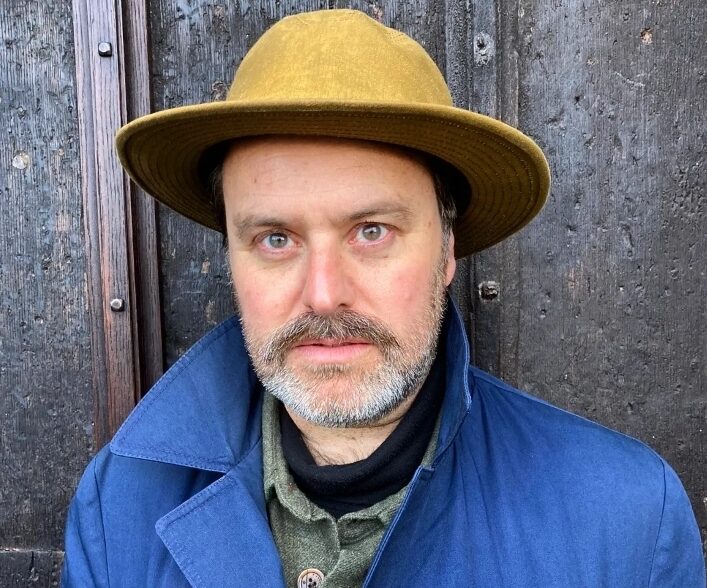
When the techno-species overlords of the near future eventually produce a university module or a museum exhibition about the ‘iconic human literature of Calderdale’, there is no doubt Benjamin Myers’ name will appear.
Myers won’t think of himself as ‘canonical’ in the sense that other heroes of the West Yorkshire borough like Hughes and Lister are. Only a few of Myers’ stories root themselves in Calderdale’s earth and explore its culture. But throughout all his writing, the aura of the valley comes through – the weird and the folkloric; the grim and the poetic – the world around him summoned to the page through style, tone, and a nuanced perspective on the human condition.
His latest release is ‘Jesus Christ, Kinski!’, available in paperback this November, a story about a malignant, mad German actor that doubles up as a confessional of the influence the valley has on Myers’ work. TSOTA spoke to the writer about these connections, and this excellent addition to the Ben Myers collection.
Originally from Durham, Benjamin left the North to pursue a music journalism career in the capital, living “in a squat in London, working for Melody Maker, Kerrang! and Mojo”, hanging out with bands, travelling to the world, and interviewing rock stars.
And yet, in 2009, it was “a little ancient cottage down a dead end lane” in the village of Mytholmroyd, next-door to Hebden Bridge with 3,500 people and a couple of pubs, that Myers and his wife, Yorkshire-born writer Adelle Stripe, ended up in.
“The best thing a creative person can do is leave London for anywhere else in Britain, or the world,” Benjamin explains. Rerouting to Calderdale meant he could take a chance on being a professional creative, without the pressure of the world’s highest rents or a £10 pint nagging the bank account. “I could work half the week doing journalism and then the other half I’d focus on the unpaid fiction writing.”
Beyond affordability and a stress-free life, the valley gave Benjamin something else just as valuable: inspiration. Not from the the unusually high density of arty happenings along the Rochdale canal – a saturation that spills over into what he calls “gentrified bulshit”. Myers is a recluse, who wanders the moors in search of ideas, returning to his study to churn out stories. “Moving here just sent my work off in a different direction, because I wanted to write about landscape, nature, and people’s relationship with it – you can’t really do that in London” he explains.
He’s clearly wary of the contrived idea of being a ‘Hebden Bridge based’ artist. But with 10 novels published since the punk reporter relocated to Mytholmroyd, winning a Walter Scott Prize and selling hundreds of thousands of copies along the way, there’s no doubt that he’s transcended that label, and become a writer of disruptively astute quality and originality, whose work competes with anything coming out of the country’s metropolitan areas.
In both subject and style, Myers defies convention. “If I was in a band, I wouldn’t be writing pop songs,” he says. “I would be trying to do something weirder, trying to push the form forward.” His prose pulls readers through beauty and brutality in quick succession, following stories about criminals, vagabonds, saints and the everyday folk of the North, with the intrigue and cynicism of a well-travelled journo. But it’s in the form & structure of his books that Myers gets most ambitious: whether it’s ‘Cuddy’, a paean to the North East, which traverses hundreds of years of history via different perspectives, letters, shrinking font size and verse; or tale of the Cragg Vale Coiners, ‘The Gallow’s Pole’, which mixes McCarthy-style narrative with the diary entries of protagonist King David Hartley, in his uncompromising, 18th Century Yorkshire vernacular.
“There’s a lot of fiction today that sticks to the rules too closely – the books that we remember as readers are the ones that are unique, or hit us at the right time, or have done something that you’ve never encountered before.”
The latest addition to the Myers experiments is ‘Jesus Christ, Kinski!’ – a fictional reimagining of actor Klaus Kinski’s infamous 1971 one-man tour, ‘Jesus Christus Erlöser’. The novel hones in on one night in Berlin, inside the spiralling psyche of a once-great actor who forgets lines, fights hecklers, cycles back through his career, and essentially, has a breakdown on stage.
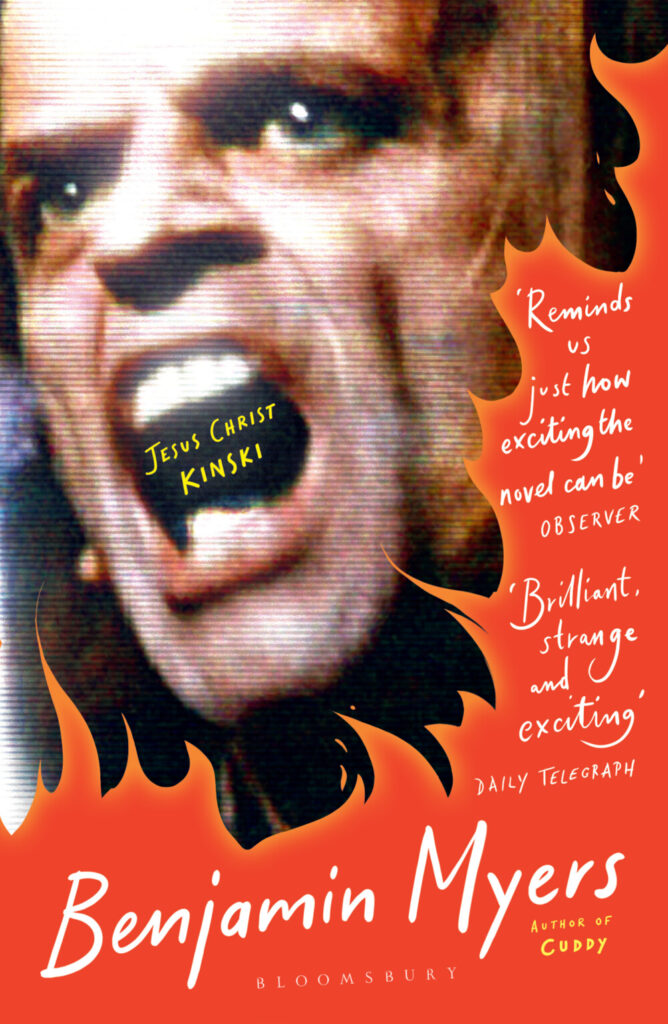
It’s a book that impresses for its audacious subject, and the way he decides to tackle it. Kinski’s mess of a performance is told in 2nd person, the voice building intensely as the event unfolds, resembling an alter-ego looking in on the mind of a man going mad, bouncing through memory and hallucination and the emotional spectrum. Myers uses the second person to explore an inexcusable figure (Kinski was notoriously volatile, abusive and often violent), but without sympathy: “I’m not saying look at this complete twat, but I’m also not saying he’s misunderstood. I’m just saying, here’s this complex person who’s amazing at one thing in life, and that’s acting. And in all of the areas of his life, he’s a terror.”
“Sometimes the worst people are the most fascinating ones.”
Myers is helped by the literary muscles he’s able to flex. Sweary soliloquays, switches of person, excruciating historical detail, a mental breakdown littered with punchlines… In ‘…Kinski’, Myers is in flow state, so confident with his instincts, that the obvious challenge of writing a compelling, potentially controversial novel about a sadistic actor having a dire time on stage, is turned into pure fun, for author and reader alike.
At one point, the Kinski story is interrupted by an autobiographical passage, that follows a “writer” working on a novel about Klaus Kinski. When he read the story of the night in Berlin, Myers realised “it’s just an angry man shouting at the reader for one hundred pages,” so “decided to write [himself] into it as a writer who’s having a dilemma about whether to pursue this project.”
The ‘writer passage’ offers reflections from the lockdown period when he wrote the book, plays out the moral conflict he had about the project, and crucially, the walk across the Calderdale moor where he had the unshakeable realisation that he had to write this book. “It was this weird merging of two very different things. The Yorkshire landscape and weather, and this obsession with this actor… I just thought, I’ll write about what it is to be a writer. And for me, a lot of it is being outside, walking, thinking – particularly here, where the air is good and you get these amazing views.”
‘…Kinski’ is a book that’s really about compulsion. Of one man who must act, must be on stage, must fight a world that he believes fails to appreciate him. And of another, who has to write what he writes, drawn to stories and a vocation and a strange village in West Yorkshire, so that his talents can fully flourish.
As a writer indebted to this corner of West Yorkshire he’s made home, for all the freedom and inspiration it’s offered him, so he could get to the point where he can confidently deliver on a project as bold as ‘…Kinski’, it’s fitting that this book should be such an honorary acknowledgement of his environment.
Adaptations of ‘…Kinski’, as well as some of his other works, are in the pipeline. Myers insists that simply the existence of his avant-garde creations is enough. “Success of something really for me is coming up with an idea as absurd as ‘…Kinski’, and seeing it through to finishing it,” Benjamin insists.
The sales won’t harm, either. “I think everyone should go out and buy a copy of ‘…Kinski’ for the relative who they hate for Christmas,” he suggests.
***
Jesus Christ Kinski by Benjamin Myers is published by Bloomsbury in paperback in November 2026.
Filed under: Writing
Tagged with: benjamin myers, Calderdale, Fiction, Hebden Bridge, interview, klaus kinski, novel, West Yorkshire, West Yorkshire Writes, writing


Comments