
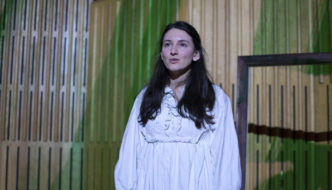
SJ Bradley. Image Credit: Ricky Adam.
SJ Bradley is a graduate of Cambridge University’s PGCert in Teaching Creative Writing and an award-winning short story writer and novelist. Originally from Wakefield, she is the author of ‘Brick Mother’ and ‘Guest‘, as well as short fiction published in various journals and anthologies. She spoke with TSOTA about her moving short story debut ‘Maps of Imaginary Towns’, published by Fly on the Wall Press in 2024. Inspired by the years of austerity under David Cameron and Boris Johnson, the collection illuminates the quiet heroism pulsing through seemingly ordinary lives.
As the title of the collection suggests, it is deeply rooted in geography and includes many recognisable places, from ‘The Stonechat’ (which SJ explains grew out of a writing retreat to Alton Towers, where participants were asked to produce a story inspired by their surroundings) to ‘Coming Attractions’, an optimistic story about a young man from Wakefield who works in the cinema, but dreams of leaving for London to pursue acting.
After a conversation with a friend during the pandemic, in which she found herself “sick of writing stories about austerity”, SJ began thinking again about the small town where she grew up. “Lots of people come from small towns and lots of people know that feeling of being trapped,” she says. It was that idea that made her want to start writing stories about her town, and others like it.
Across the collection, SJ writes towards experiences often dismissed as mundane. Fiction frequently focuses on the drama of reinvention in big cities, but rarely lingers on the backstory: the leaving, the stuckness, the small-town inertia that shapes so many lives. “If I’m writing for anybody,” she says, “I’m writing for people that will read this, pause and think, ‘Oh, I recognise that place,’ or, ‘I know that person,’ or, ‘That’s happened to me.’ I think there are a lot of people that don’t really get their experiences written about in fiction, and I want people to recognise themselves in mine.”

Cover Maps of Imaginary Towns. Image Credit: Fly on the Wall Press.
An especially resonant example is ‘The Gordon Trask’, which centres on an almost magical council-run music centre that suddenly shuts down. Many readers will recognise the grief that follows the loss of such spaces. SJ notes that she has worked extensively in council roles and charities and has witnessed these closures first-hand. “As the world continues, it’s so easy to feel like you are the only person this devastating thing is happening to. I like to write about those experiences to make people feel less alone. I think fiction is really important for that.”
Libraries, schools, community centres, cinemas, these everyday spaces form the emotional architecture of the collection. Their familiarity gives the stories an intimate quality, as though they are written in direct conversation with the reader. As SJ puts it, recognition offers a kind of narrative security: when readers see their own cinema, their own street, or something close to it on the page, the story becomes theirs too.
Much of the collection draws on the lived realities of austerity under Cameron and Johnson. ‘Dance Class’, which follows a woman attempting to escape an abusive relationship, was written after SJ read about the closure of refuge centres unable to accommodate women in need. “It made me question what you do if you’re trying to escape and there’s nowhere for you to go.” Other stories, including ‘The Gordon Trask’ and ‘Discrepancy Matrix’, draw on her experiences working within local government.

‘Maps of Imaginary Towns’ Book Launch with Stu Hennigan. Image Credit: Ricky Adam.
What distinguishes the collection, however, is Bradley’s interweaving of present-day realism with speculative and dystopian elements. These stories exaggerate unsettling truths about contemporary Britain, forcing the reader to confront issues we often shy away from. ‘Backstreet Nursery’, for example, explores a world in which adults are required to take turns serving as politicians. Though science fiction in premise, it remains firmly rooted in social commentary and real life. SJ traces its origins to a social media post she saw after Brexit suggesting mandatory political service and IQ tests for voters.
Similarly, she wrote ‘Life of Your Dreams’, a story about a migrant worker’s exploitative experience on the rocket-ship Ganglian-A as she flees ecological disasters on Earth, over a decade ago, during a period of intense media hostility around immigration. “I was really interested in trying to explore the reality of migration,” she says. “People don’t come here and have a wonderful life where they are given loads of money and a lovely place to live. It just isn’t like that.” By relocating these debates into imagined worlds, Bradley creates space to examine systems and politics that cannot easily be addressed in reality.
SJ is also the author of two novels, ‘Brick Mother’ and ‘Guest’, but she describes short stories as a liberating form. “It is quite freeing to write a short story because the brevity gives you more space to experiment,” she says. “Because it’s so short, you can write something that is a bit odd and, if it doesn’t quite work, you can try something else without it impacting an entire plot.” Whereas the novel often follows a single character over an extended arc, the short story captures a moment, a flashpoint intended to linger with the reader.

SJ Bradley at Holdfast Books in Leeds. Image Credit: SJ Bradley.
These moments feel central to ‘Maps of Imaginary Towns’. Many of the stories offer only fragments of a life, a single day, a turning point, or a few transformative months, leaving readers wondering what happens after the final line. For SJ, this open-endedness reflects life itself. “You don’t, for example, get married, live happily ever after and life stops there. It continues, and I’m really interested in that.” Through these fleeting moments, the collection resists neat resolution. Instead, it suggests that the quiet, everyday acts that make up these stories are as important as what might come after.
The collection takes its title from one of its stories, in which a young boy invents inner worlds to cope with family tragedy. Bradley chose it to reflect the optimism that runs through the whole book. “Throughout, the characters find that inner strength and grit to forge a new life for themselves and do exciting things. And to do that is an act of imagination. You have to imagine a life for yourself that’s better than what you’ve got.”
‘Maps of Imaginary Towns’, then, gestures toward the private cartographies we create in times of crisis, the mental blueprints of escape, reinvention and hope. Even amid austerity and loss, Bradley’s stories insist on imagination as a form of resistance. No matter the struggle, there remains the possibility of something just beyond the horizon, waiting to be mapped.
***
‘Maps of Imaginary Towns’ is available to buy online and in-store at Waterstones, and local bookshops like Holdfast Books and Truman Books. You can keep up to date with SJ’s work on her website and Instagram.


Comments