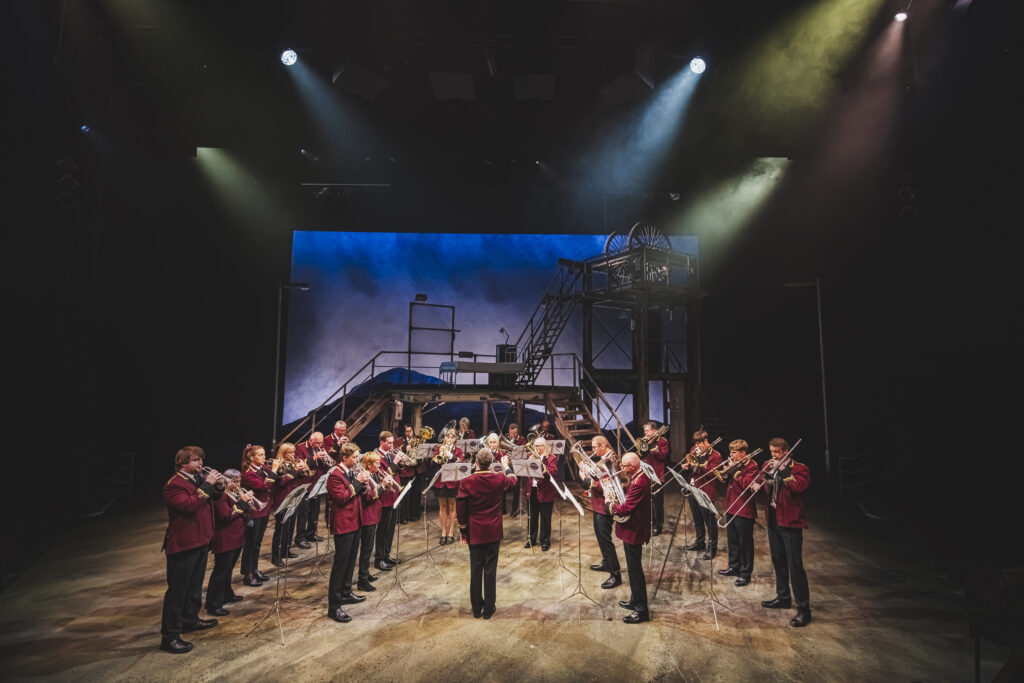
The Brassed Off company. Photo by Kirsten McTernan.
One of the great perks of being part of such a wide local arts scene is that you are bound to be connected with people who make the step up to high-profile events and productions. I met local poet, storyteller, actor, playwright and producer Pauline Tomlin last year at Tony Tokundo’s Africa4U awards in Bradford, where she picked up a prize for her play ‘The Lives We Carry’. When a stage adaptation of the classic Yorkshire film ‘Brassed Off’ came to the Leeds Playhouse recently, I would certainly have gone to see it under any circumstances, but since this was Pauline’s first appearance on such a high-profile stage, it was lovely to have a personal connection to the production.
Her role was Rita, wife of Harry, played in the film by Jim Carter. On screen, Rita and Harry are seen constantly passing each other in and out of their house with barely a greeting, and she only gets to speak briefly near the end. Pauline’s Rita, however, has far more to say, largely because the stage production incorporates elements of Ida’s role into hers. Like Vera’s Ida in the film, she goes everywhere with the band, giving her character more depth. We see her share with Vera the role of comic turn and community stalwart, while also taking on the exasperation and social conscience of the film’s Rita.
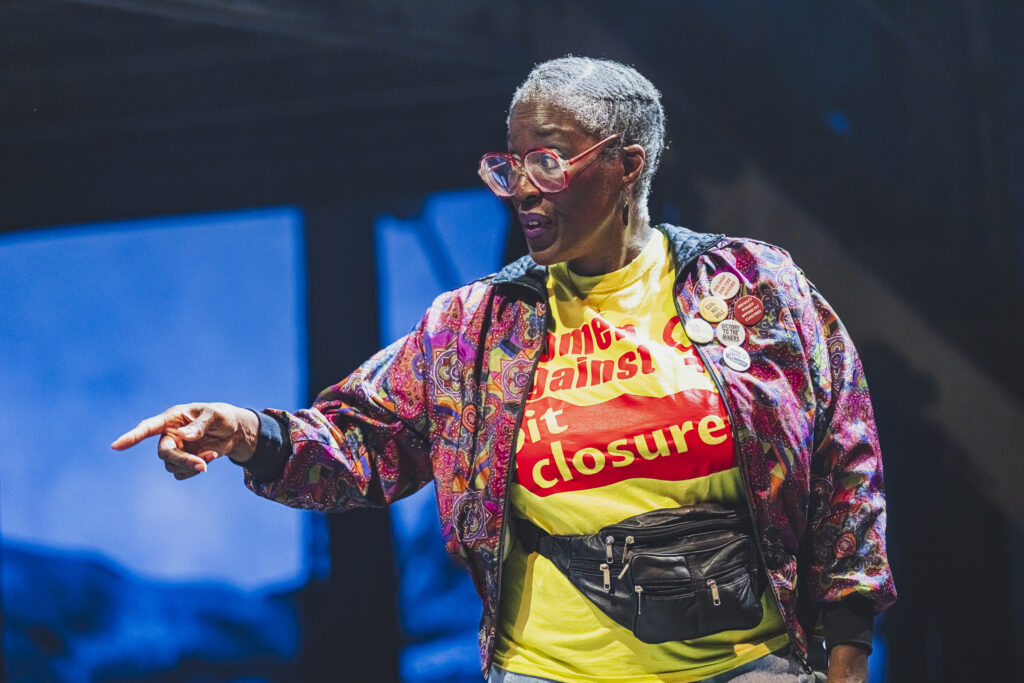
Pauline Tomlin (Rita) Brassed Off. Photo by Kirsten McTernan.
Adapting a film for the stage is always fraught with difficulty. Without the broad locations and the close photography, the theatre and stage directors have to be very resourceful to achieve both the breadth and intimacy that the screen affords. But overall – and much as I love the film – this adaptation compares very favourably with the film, and does quite a few things even better. A comic moment from early in the film is the first practice session in which bandleader Danny responds to the band’s rendition of The Floral Dance with “well, that were crap”. On screen it is mildly amusing, but in a theatre where the audience has just given it a wild ovation, it hits much harder!
Danny goes on to trot out the old Morecambe and Wise line about playing all the right notes but not necessarily in the right order. A notable thing about the play is that the soundtrack may be similar but not all the pieces are in the same order. For example, unlike the film, this production opens with a lone cornet playing “Jerusalem”, which works particularly well against the looming stage set, shaped like a pithead and shaft and used ingeniously throughout.
It became easy as the play went on to take for granted how much work the stage-set was doing. But from the early scenes, which showed in painfully claustrophobic detail the miners at the coalface, going up and down to work in a cage-lift, and then used the same space to convey the claustrophobia of Phil and Sandra’s marriage, I knew we were in the hands of people we could trust.
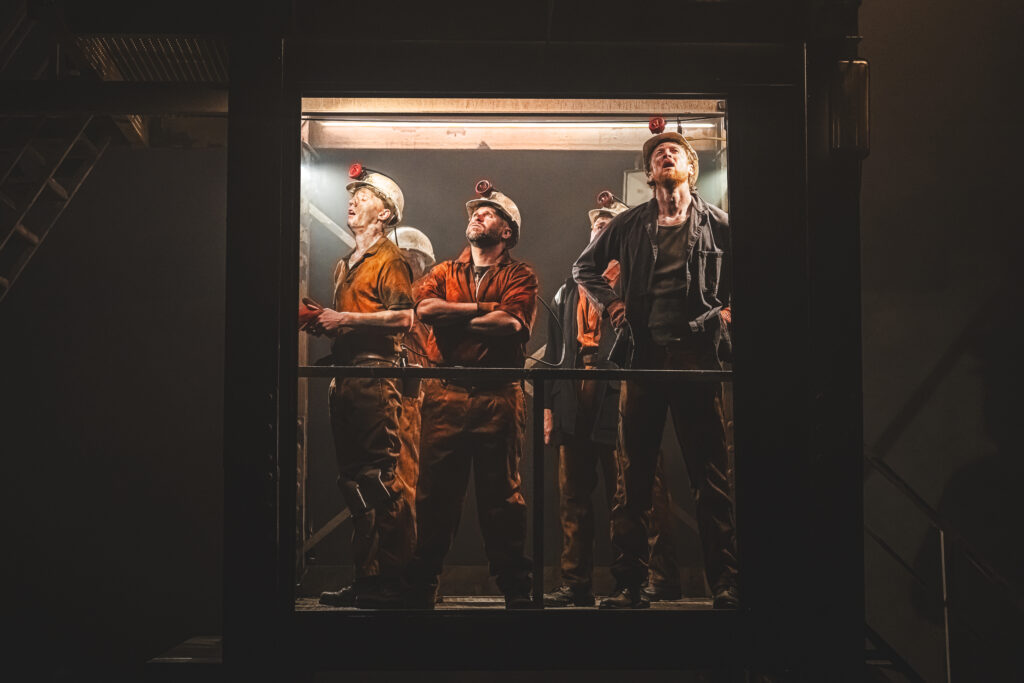
Brassed Off. Photo by Kirsten McTernan.
A musical piece which did take place at the same time as in the film was Gloria’s flugelhorn interpretation of Joaquin Rodriguez’s iconic second movement of his Concierto de Aranjuez (comically called Orange Juice both on screen and stage). This rendition – and the story of Andy and Gloria generally – is where the stage version knocks the screen one into a cocked hat. To my mind, the Andy and Gloria story 30 years ago (played by British box-office gold of the time Ewan McGregor and Tara Fitzgerald) weakens a brilliant film by reducing it to cheesy romantic comedy under the pretence of giving us an “in” to the overarching political machinations. This stage version of that part of the story is still a bit cheesy, but it tones that element down and makes this a more believable strand and, crucially, doesn’t over-centre it. Hence, while I found Fitzgerald’s Orange Juice cringeworthy and incredulous in the film, here it was as rousing and moving as such a piece should be. And at the end of the show, while the lovers do share a clinch as part of a broader tableau, we were spared the Hollywoodian closing image of Andy and Gloria snogging on the open-top bus.
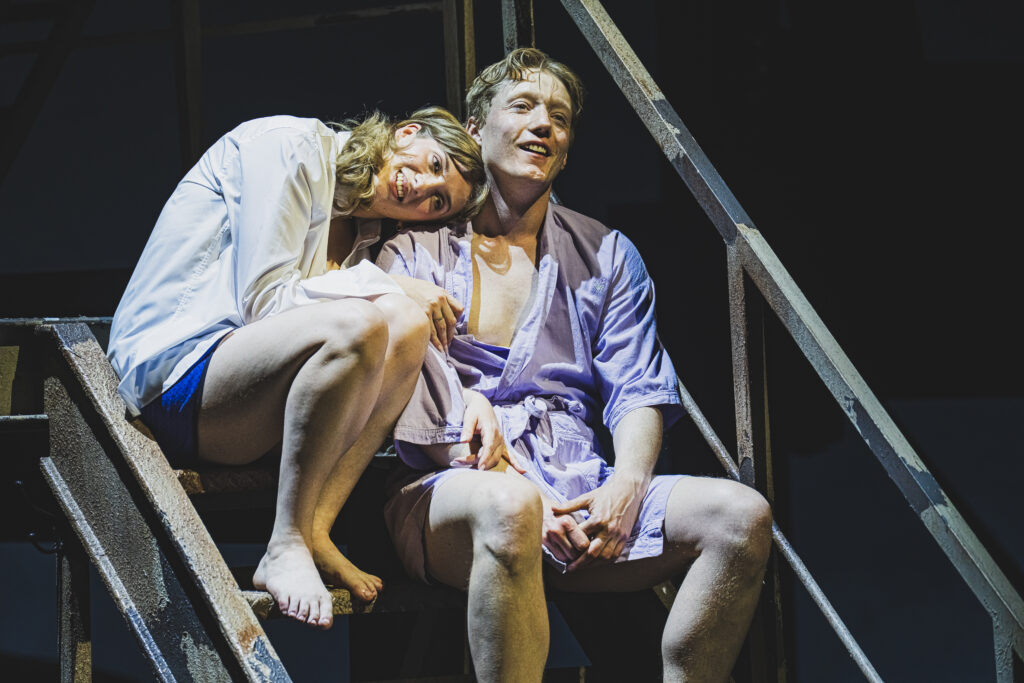
Maddie Hansen (Gloria) Frazer Hadfield (Andy) Brassed Off. Photo by Kirsten McTernan.
A particularly strong variation from the film is a scene where Danny and his grandson, Shane, play Nimrod on Danny’s gramophone and Danny shows Shane how to conduct it. At the end of the play, Shane comes on to conduct the band after their big win at the Albert Hall – the only part where I felt the stage show lost its way – but that earlier scene was magnificent.
While the comedy of this adaptation was first-rate – Rita and Vera were a huge highlight, as was the sequence of the band getting progressively pissed in Saddleworth (and district), fraying drunkenly at the edges as their playing skills slackened and the nuts and bolts, and the wheels, came off – the pathos was at times also unbearable. Much of this was because one could feel the frustration of an oppressed and hard-bitten community, much of it because the in-fighting was so obviously to the advantage of the oppressors, and of course a lot of it was to do sad storylines: Phil and Sandra’s failing marriage, Phil’s breakdown and attempted suicide, Danny’s debilitating miner’s-lung illness, the looming shadow of the stage-set. Everything – illness, squabbling, kitchen-sink drama – was in the literal shadow of the towering pit-head, and often the band played in this shadow as bailiffs ripped the heart from a family home, as communities frayed at the edges and, most movingly of all, when they played Danny Boy outside Danny’s hospital window.
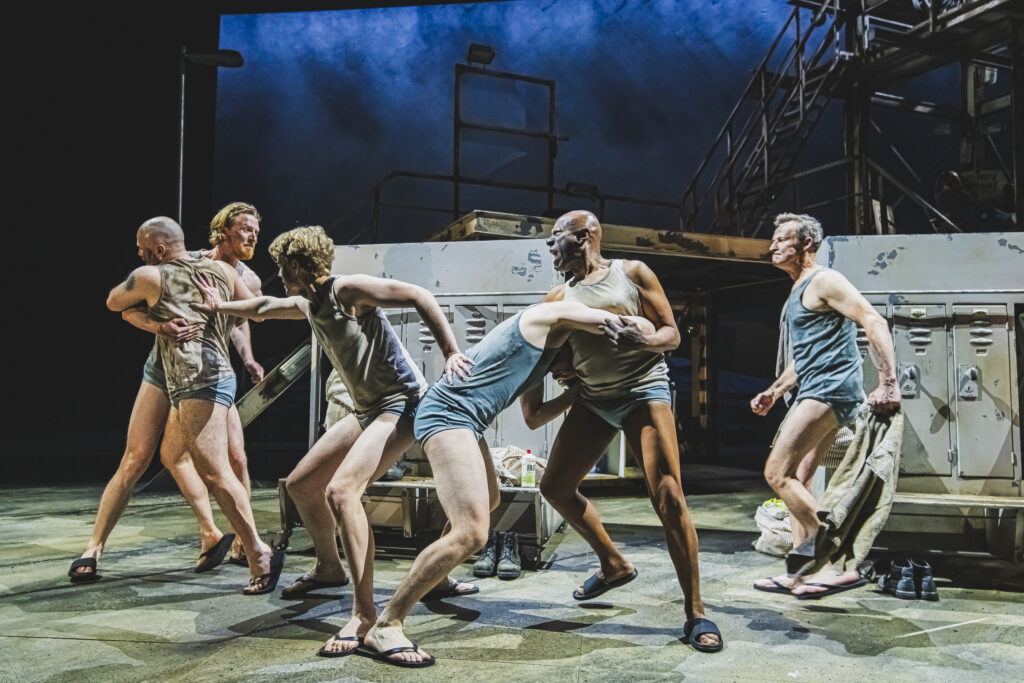
Brassed Off. Photo by Kirsten McTernan.
All the while, the stage, the community, the band and their clinging to hope become a metaphor for what was happening in the background. Pit-bosses planning to close the pit while playing divide-and-rule with the community by dangling the carrot of a £20,000 redundancy package, which, as in the film, is accepted by a 4-to-1 vote. Again, the stage version deals with this more strongly than the film, by highlighting the real poignancy of the dilemma, in that the money is huge and can change so much and yet is also so little and so unlikely to have a long-term benefit.
Danny’s iconic closing speech is – if it were possible – even more moving than the immortal Pete Postlethwaite’s screen version. I think because it was foreshadowed more strongly with the earlier point Danny makes about how when the working men are dead and the pits are gone, the music will still be there. This intensifies the way he rows back on it to say that it’s people and communities who are the really important thing. And anyone who reads my columns will know he was preaching to the choir on this.
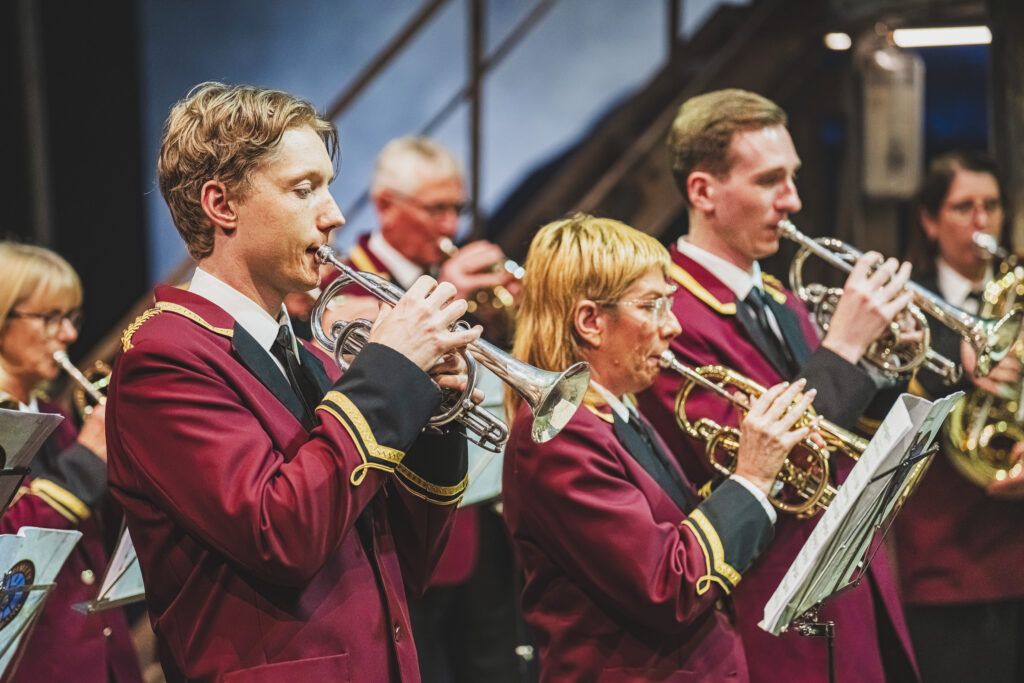
Frazer Hadfield (Andy) with the company of Brassed Off. Photo by Kirsten McTernan.
However, I should like the last words of this review to return to Pauline Tomlin, happily hanging out with “Shane” in the wings at the end and clearly lapping up the incredible atmosphere as the crowd gave the well-deserved ovations. My column at the end of March this year asks the question “Is it Really Too Late?”, meaning are some of us too old to take up the creative life? Pauline epitomises what I was saying in that piece. Her first role in a major production comes at the age of 61, having only taken up acting at the age of 56. For it to come in a famous story about never abandoning hope is particularly apt.
***
To keep up to date with all of Leeds Playhouses’ in-house and touring productions you can check out their instagram and website.
Filed under: Theatre & Dance
Tagged with: Brassed Off, comedy, community, leeds playhouse, oppression, orchestra, performance, theatre
Comments