
West Yorkshire Writes: Jordon Scott Kennedy on ‘Rocket Fuel’ and reimagining working-class stories – Interview
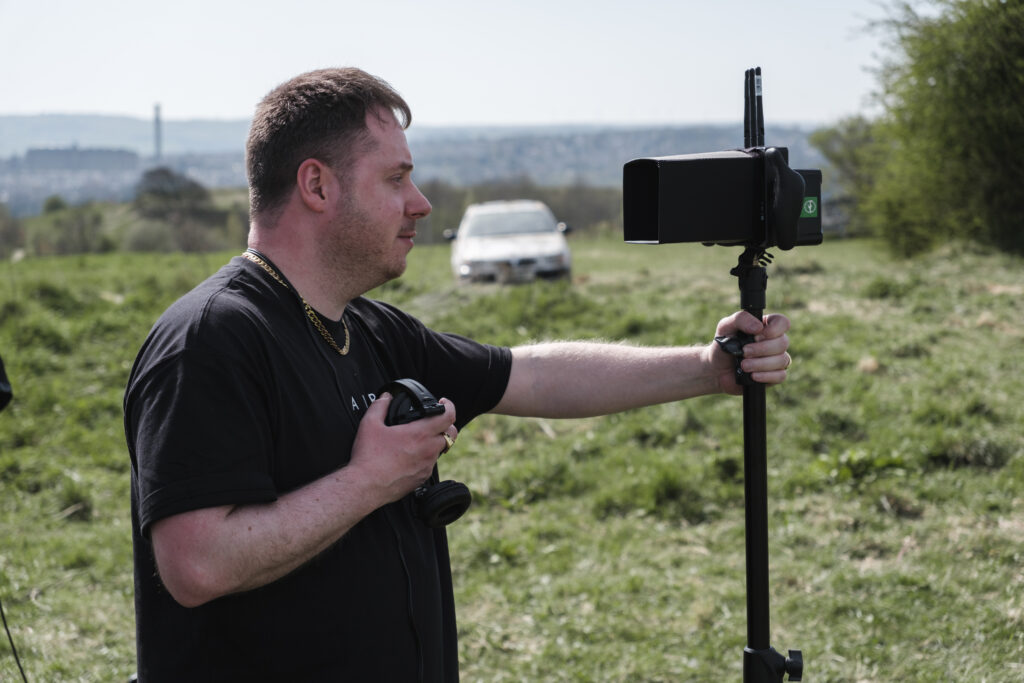
Jordon on set of ‘Rocket Fuel’. Photo Credit: Jack Bolton, @jckbltn.
BAFTA-nominated writer-director Jordon Scott Kennedy has built a career telling stories rarely seen on British screens. Raised in Dewsbury and now living and working in Bradford, his work centres working-class lives with warmth, humour and emotional honesty. His debut feature, ‘Suicide Kelly’, won Best Picture and Best Director at the BAFTA-accredited British Urban Film Festival, while his BBC Three short ‘Rocket Fuel’ attracted more than 30 million online views and earned a BAFTA nomination. We met Jordon to discuss his journey into filmmaking and why authentic working-class representation matters.
Jordon’s path into film was anything but straightforward. “It’s all I wanted to do,” he says. “From the age of ten, I worked as a painter and decorator. Dewsbury had very few creative opportunities, so filmmaking was never considered a realistic avenue.” Instead, he found himself working in retail, quietly writing scripts on boring shifts. “I went out one night, got pretty drunk and sent an email to the Northern Film School with some scripts attached,” he laughs. “I didn’t remember doing it, but a couple of days later they invited me for an interview.”
The interview changed everything. “That was the first time anyone had told me I was good at writing,” he says. Despite leaving school with few qualifications and being told university wasn’t for him, he was offered a place. Within a year, he was achieving first-class marks across every module, “I didn’t even recognise myself anymore. That’s how I got my first start.”
‘Goodfellas’ was the first time Jordon was obsessed with finding out who was behind the camera. “From there I was obsessed with Martin Scorsese.” Film school encouraged him to dig further. “I started watching the filmmakers who had inspired my heroes: ‘Breathless’, the French New Wave and Italian cinema like ‘Bicycle Thieves,’” he says. “I kept going further and further back until I ended up obsessed with silent cinema and Charlie Chaplin.”
That curiosity shaped the way Kennedy approached filmmaking. Rather than trying to perfect everything at once, he treated each project as a chance to develop a new skill – a philosophy he now passes on to his own students. “Every film is about trying to add something to what you are as a director,” he says.
As Kennedy grew more confident as a writer, he began pushing himself in new directions, experimenting with genre and visual style. ‘Rocket Fuel’, his latest short, marked his first venture into making a pure comedy intended to make audiences laugh. The film follows two bored children on a Bradford council estate whose discovery of an abandoned car sparks a journey into outer space.

Lenny and Mullet travelling to space in ‘Rocket Fuel’. Photo Credit: Jack Bolton, @jckbltn.
Writing it, he says, came unusually easily. “It felt like it dropped out of the sky. It took four hours to write and that first draft won two competitions and got BBC funding.” Filming proved more challenging. Initially hampered by bad weather and a demanding schedule, the production found its rhythm once everyone was on set. “I had this absolute dream team,” he says. “The sun came out, everyone started pulling together and there was a feeling that something special was happening.”
That sense of optimism defines ‘Rocket Fuel’. At a time when working-class stories on screen are often rooted in hardship and social realism, Jordon set out to tell a different kind of story, one of joy, imagination and possibility. “I’ve been to lots of festivals and sometimes you’re up against some really bleak stories,” he says. “The director will stand there and say, ‘I’m showing the world the way it is.’ That’s great, but I could just look out a fucking window. As someone whose job is to create fiction, I think there’s a lot to be said, at a time when we’re saturated by bleak news and media, for not just holding up a mirror to society but making people laugh, giving them hope, inspiring young working-class people that they aren’t just destined for ruin.”
‘Rocket Fuel’ celebrates children as imaginative, resilient and resourceful. Its young protagonists, Lenny and Mullet, may inhabit a world of burnt-out cars, tower blocks and eccentric local characters, “loads of things that are red flags”, but “they’re having the time of their lives,” Jordon says. He believes this is why audiences connected with the film so well: they recognised something familiar in its characters and setting.
The specificity of what street the characters live on, what their upbringing is and who their best friends are allows a story rooted in one place to reach people everywhere. Beneath the Bradford estates and local references, ‘Rocket Fuel’ captures a childhood experience that is far more universal. “Everybody’s had that ‘Rocket Fuel’ kind of day where you build a treehouse, go swimming in the local beck or get lost in the woods,” he says.
“People see kids speaking in regional accents and feel seen,” he says. “You never see young working-class kids from Bradford in films like ‘The Goonies’. You’ve got to be American or speak with an RP accent to go to Narnia. But why can’t I send a couple of charvers to Narnia?”

Lenny and Mullet travelling to space in ‘Rocket Fuel’. Photo Credit: Jack Bolton, @jckbltn.
Despite making several films with first-time child actors in leading roles, Jordon warns “you’ve got to be at the top of your game.” For him, the key to success is finding children who already possess something of the character they’re being asked to play. “You don’t get a kid to try and act,” he says. “You get a kid who is the closest thing you’ve met to your character, then you get out of their way and let them bring the character to life.”
Jordon knew Elif, who plays Lenny, was right for the role almost as soon as she walked into the audition. “The door swung open and barely missed me. She swaggered in and said, ‘Which one of you lot is Jordon?’ I thought I was in trouble. Then she said, ‘You know my sister. You put her in a film. You’re gonna put me in this film.'”
When she performed a scene shouting from the window of the abandoned car, she made no attempt to hold back. “She was red in the face, making sure the whole building could hear her,” Jordon laughs, “I was just like, ‘She’s got it.'”
Finding Logan, who plays Mullet, completed the picture. While Elif brought boundless energy, Logan’s calm temperament balanced the partnership and their chemistry proved impossible to manufacture.
Although they auditioned together by chance, each child’s first question after being offered the part was whether the other had been cast too. By the time they arrived on set the following week, they had already memorised the entire script after rehearsing together on FaceTime. “I was like, ‘“How the chuff?’ I don’t even know the script.'”
Jordon’s confidence in them only grew during a script reading organised for the BBC. He hired a theatre and encouraged the children to perform the script as though it were a play. “The audience were laughing their heads off,” he says. “They were like Laurel and Hardy, dragging jokes out and milking them when people were really laughing. Watching them, I thought, ‘Jackpot. I’ve got two geniuses here.‘”

Elif Riley and Logan Ludbrook with Jordon. Photo Credit: Jack Bolton, @jckbltn.
When ‘Rocket Fuel’ premiered on BBC Three, the response exceeded all expectations. The film quickly amassed more than 30 million online views, later winning the Yorkshire Short Film Competition at Leeds International Film Festival and earning a BAFTA nomination. Even now, he says, the film’s reach still catches him by surprise. “I teach at MetFilm in Leeds and, this year, about 70% of the students had already seen ‘Rocket Fuel’. It blew me away.”
“Three years ago, I was on Universal Credit,” Jordon says. “Now I’m a full-time filmmaker.” From writing scripts in spare hours to sitting in meetings with Hollywood studios, Jordon’s journey feels like an adventure from ‘Rocket Fuel’ itself – a story built on imagination, persistence and the belief that something bigger is possible.
***
‘Rocket Fuel’ is available to watch now on BBC iPlayer.
To keep up to date with Jordon and his latest work, follow him on Instagram.



Comments