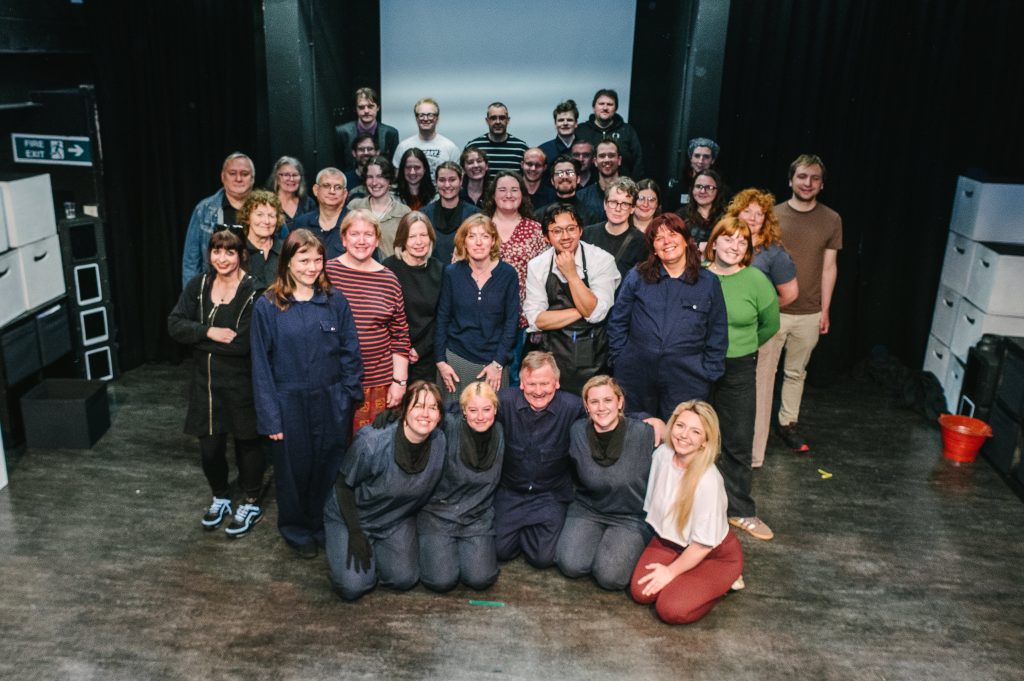
1984 (Full Cast and Crew). Image Credit: Mark Hillyer (TrueNorth photography).
Formed in 1945, Leeds Arts Centre (LAC) is a prestigious amateur theatre company with a long history of producing an eclectic mix of work, from Shakespeare and classics to new writing. Their latest production, directed by Sophie Clement, turns to ‘1984’, reimagining Orwell’s bleak Oceania in a faithful and absorbing adaptation that brings the novel’s enduring warnings sharply to life.
A registered charity and part of the Leeds Community Arts Network, LAC has evolved significantly over the decades. Once comprising multiple artistic sub-groups (including fine art, film, and children’s theatre) it is now based at the Carriageworks Theatre, where a dedicated writing group and team of volunteers stage around four productions each year. This context makes the ambition of ‘1984’ all the more striking: a complex, politically charged work tackled with imagination and confidence.
The production opens with party slogans blaring through the theatre, as Winston Smith (Connor Houlton) appears isolated and subdued, mechanically rewriting history for the Ministry of Truth. His outward conformity and submission to routine is immediately established through a striking visual sequence. Under strobe lighting and a relentless, rhythmic soundtrack, Winston and his fellow citizens march through the monotony of their daily lives. The effect is both unsettling and effective, capturing the dehumanising machinery of the Party.
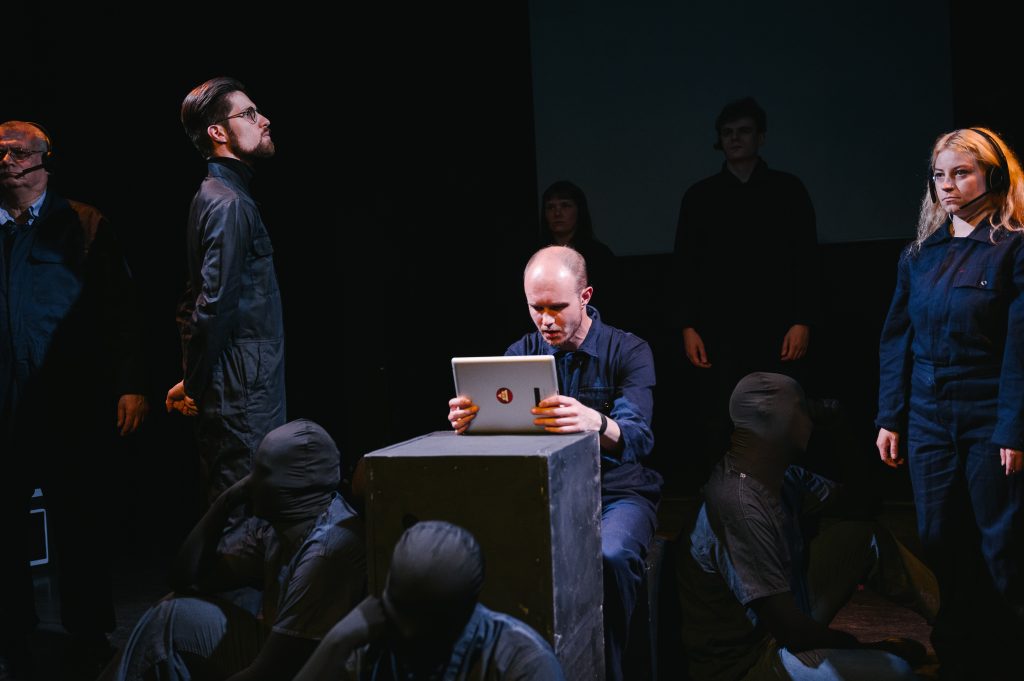
1984 (Winston – Connor Houlton, O’Brien – Francis Simmons, Ensemble – Louise Redfearn, Barry Blatt, Figments – Adam Churchman, Kayleigh Littlemore, Nicole Smith, Kathryn Green). Image Credit: Mark Hillyer (TrueNorth photography).
Yet beneath this compliant surface lies a growing rebellion. This tension is vividly externalised through a group of performers (played by Adam Churchman, Kathryn Green, Kayleigh Littlemore and Nicole Smith) who embody Winston’s unspoken thoughts and emotions. These “figments” function as shadows of his consciousness, shifting from disgust at Syme’s erasure of language to fear in the presence of the Parson children, whose playfighting reflects the regime’s reach. Their presence is one of the production’s most inventive choices, giving form to the psychological strain at the heart of Orwell’s story.
Julia, portrayed with confidence and nuance by Sophie Curtis, is another highlight. Often criticised as underdeveloped in the original text, here she emerges as a fully realised and compelling figure. Sophie brings warmth, defiance, and clarity to Julia’s motivations. In a particularly effective scene set in a crowded market, the pair’s conversation is staged using raised wooden boxes that allow them to blend into the crowd while remaining visible to the audience. It is a simple but clever device that underscores both the danger and exhilaration of their connection. Julia’s philosophy, small acts of rebellion as a means of preserving humanity, feels not only convincing but quietly radical.
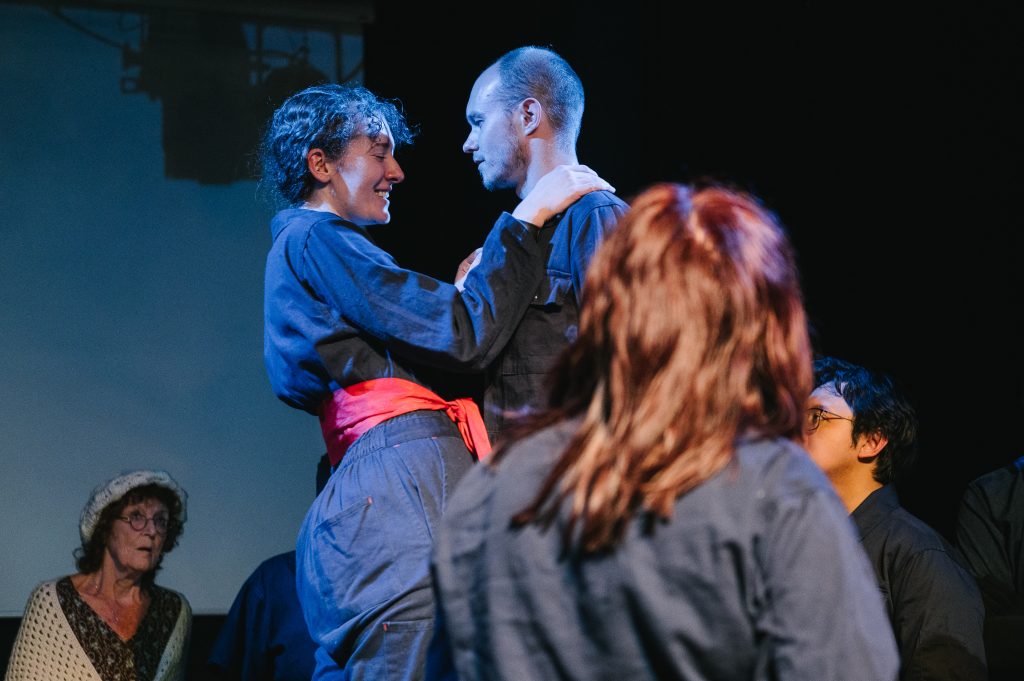
1984. (Charrington – Pam Wilson, Julia – Sophie Curtis, Winston – Connor Houlton, Prole – Michelle Whitaker, Syme-Aiman Sulehuddin). Image Credit: Mark Hillyer (TrueNorth photography).
The staging throughout, led by Paul Comaish, is minimal but purposeful. The figments reconfigure wooden black boxes to suggest different spaces: a desk and laptop for the Ministry of Truth, a sparse bedroom, the remnants of an antique shop. This stripped-back aesthetic mirrors the ideological barrenness of the Party’s world. Meanwhile, the use of projection, most notably during the Two Minutes Hate, adds a layer of menace, reinforcing the ever-present gaze of Big Brother. Tablets embedded within the set further emphasise this sense of constant surveillance.
If the first act carefully builds the world and its tensions, the second delivers the full force of its brutality. The production preserves the episodic structure of the novel, but the drama intensifies as Winston’s fragile resistance collapses under the Party’s power. The production does not shy away from the bleakness of Orwell’s vision; instead, it leans into it, capturing the inescapability of a system designed to eradicate not just dissent, but the very possibility of independent thought.
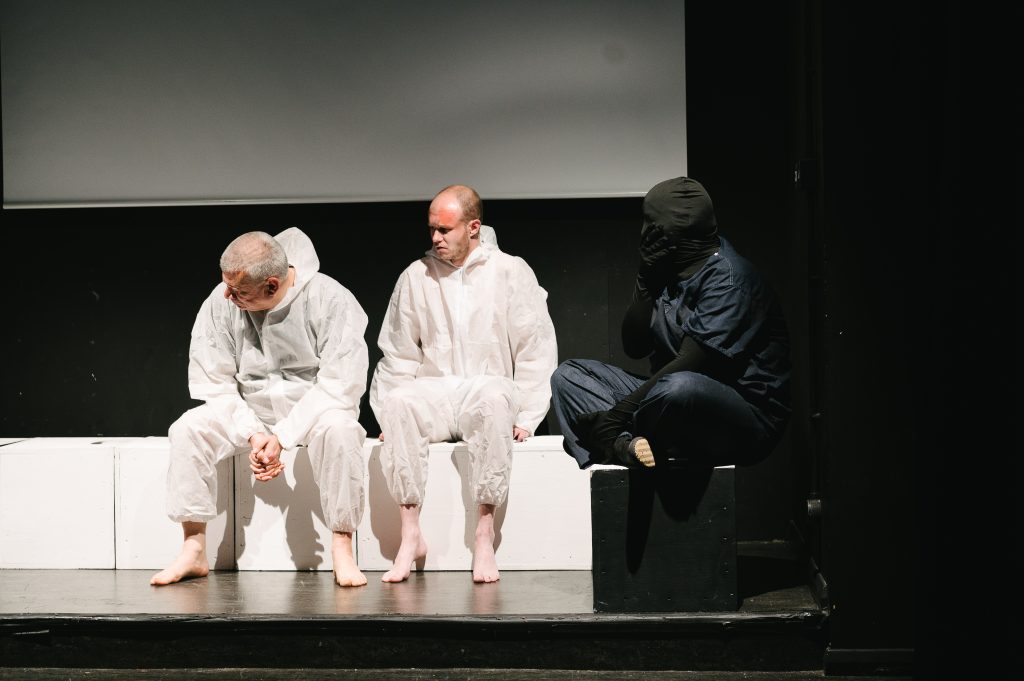
1984 (Mr Parsons – Barry Blatt, Winston – Connor Houlton, Figment – Kathryn Green). Image Credit: Mark Hillyer (TrueNorth photography).
This is an ambitious and thoughtfully realised production that demonstrates the strength of community theatre. With limited resources but clear artistic vision, Leeds Arts Centre delivers a compelling adaptation that feels both faithful to its source and resonant for contemporary audiences. Inventive, unsettling, and emotionally grounded, it lingers long after the final scene.
***
‘1984’ by Leeds Art Centre is showing at The Studio Carriageworks Theatre from Wednesday 29th April – Saturday 2nd May with tickets still available.
For more information about Leeds Arts Centre visit their website and Instagram.
Filed under: Theatre & Dance
Tagged with: 1984, amateur theatre, Carriageworks theatre, community theatre, dystopian literature, George Orwell, Leeds Arts Centre, The Studio


Comments