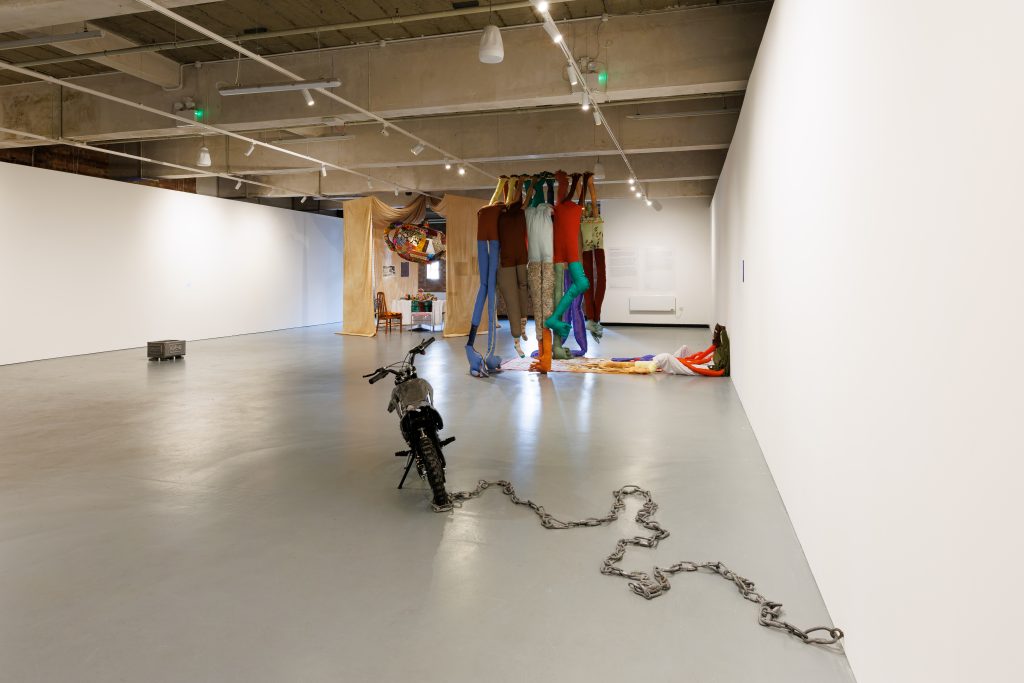
Installation of OUR TURN: Practice Bradford 2025, Yorkshire Contemporary. Image Credit: Jules Lister.
‘OUR TURN: Practice Bradford’ is a group exhibition showcasing ambitious new work by four emerging artists – Joanna Byrne, Atiyya Mirza, Liv Preston, and Saba Siddiqui. Taking place at Loading Bay from 18 September to 19 October 2025, the exhibition marks the launch of ‘OUR TURN’, a new visual arts festival and a key moment in Bradford’s UK City of Culture celebrations, as the city looks ahead to hosting the Turner Prize.
This exhibition is the culmination of ‘Practice Bradford’, an artist development programme led by Yorkshire Contemporary and Bradford Producing Hub. Supporting emerging talent through mentoring, funding, and peer networks, the programme forms part of ‘Our Turn’ – a city-wide festival celebrating Bradford’s thriving visual arts scene during its Turner Prize host year. Highlights include the Bradford Art Show, the Artists’ Showcase, and the Print Collection – all showcasing the city’s artistic diversity.
The first thing that strikes you upon entering ‘OUR TURN: Practice Bradford’ is Atiyya Mirza’s large-scale textile installation. At its centre, two women are propped up against the wall, surrounded by shattered plates inscribed with the Urdu words shadi, mamta and talaq – meaning marriage, motherhood, and divorce. Towering, draped fabric figures hang above a colourful plastic sheet laid in front of the women, gently enclosing the space and inviting the viewer to sit.
Mirza’s installation evokes intimacy within the stark, white-walled gallery. The hand-stitched fabric figures – comically oversized with large hands and feet – soften and shrink the space to the scale of a living room. This cocoon-like setting creates a safe and comfortable space that invites conversations around cultural identity and the taboos that define women’s lives. The smashed plates symbolise not just broken ceramics, but shattered expectations. Using traditional fabrics and found materials, Mirza playfully explores domesticity, childhood and gender roles.
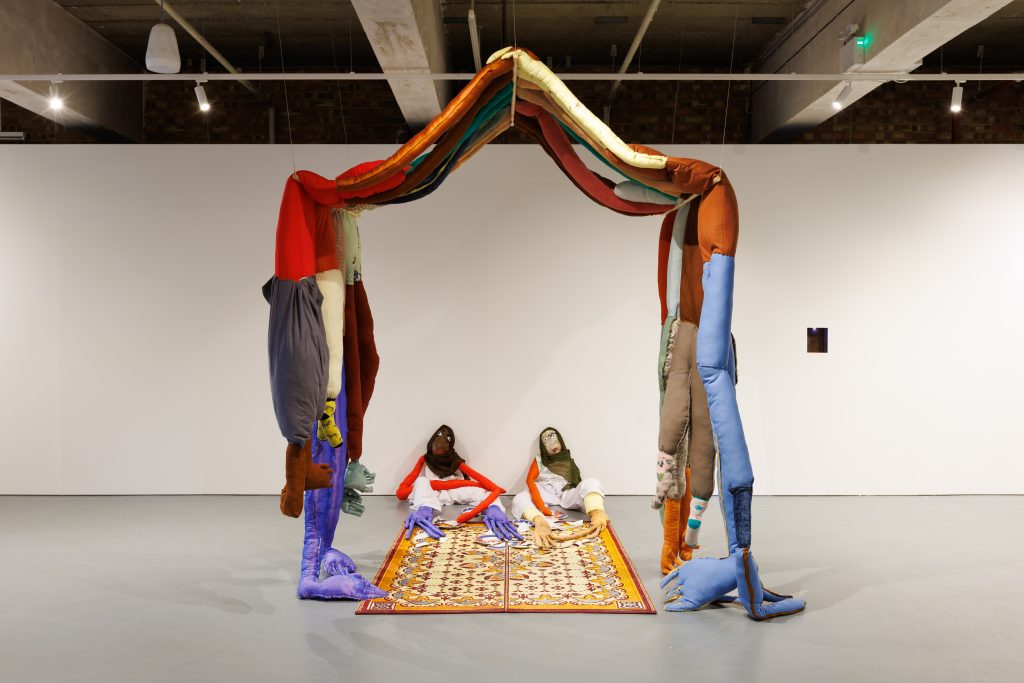
Atiyya Mirza, Our Ghar. Image Credit: Jules Lister.
Also working with textiles, sculpture and printmaking, Saba Siddiqui’s work examines Bradford’s histories of textiles, migration, and labour. Centered on the idea of industrial tea breaks, the installation features a vibrant quilted teapot suspended above a circular table covered with quilted kettles, cups, and biscuit tins. Light brown curtains envelope the space, separating it from the rest of the exhibition and creating warmth and intimacy.
Some of the tins invite viewers to lift the lid and smell, engaging the senses while exploring tea breaks as moments of both rest and resistance. Printed questions like “What is progress and who is it for?” turn the table into a site of political reflection and resistance. Transcripts of real workplace conversations – including one where an Asian man recalls an employer saying they “didn’t intend to recruit Asian workers” – sit alongside posters referencing strike action in Bradford. Overhead, recorded tea break conversations embed the viewer in a living archive of everyday moments that have been catalysts for industrial change, inviting viewers to come together and engage in dialogue and reflection on systemic inequality.
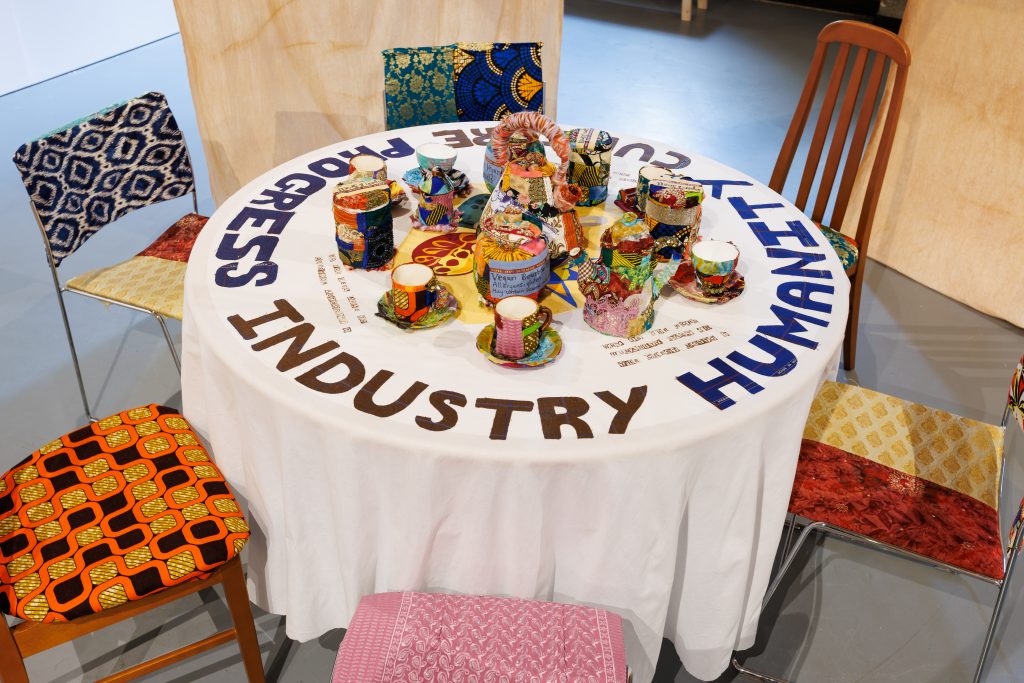
Saba Siddiqui, A Well Deserved Cuppa. Image Credit: Jules Lister.
Joanna Byrne’s installation uses photography, moving image, sculpture, and field recordings to explore a post-industrial site in Shipley. Framed by a black curtain, it creates a contained, immersive space. Just outside the curtain, a vintage television loops footage of lorries and traffic passing the site – highlighting its overlooked place in the modern landscape.
Inside, a projection of plants from the site is cast onto the left-hand wall. A second projection illuminates a concrete slab, casting shifting shadows of plant life, across its warm yellow surface – its texture deepened by the soft, rhythmic clicking of the slide projector. A second retro television mirrors the one outside, playing quiet, intimate footage of the plants and wildlife growing there. The contrast shifts focus from industrial present to the vitality of in-between spaces – sites of ecological persistence common in Bradford. Byrne’s installation is both homage and intervention: using film footage to honour the cinema that once stood, while revealing the quiet abundance hidden within sites of urban decay.
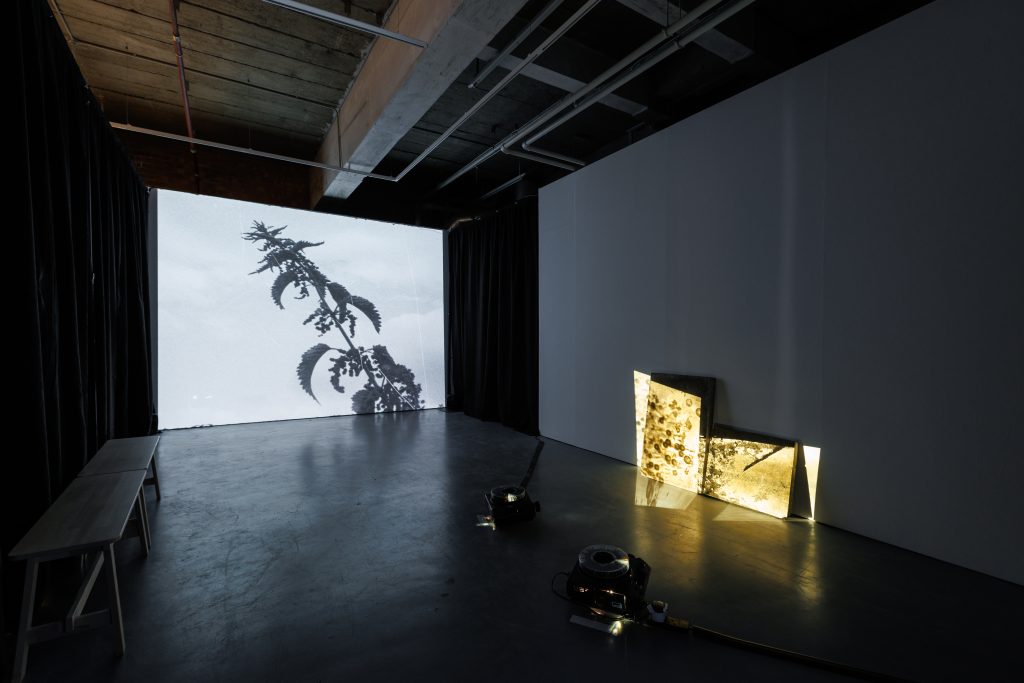
Joanna Byrne, Past Lives. Image Credit: Jules Lister.
Liv Preston’s installation is dispersed throughout the space. Combining sculpture, conceptualism, and material culture, her work draws on underground features, hobbyist communities, and industrial legacies – fusing historical research with site-specific materiality and speculative storytelling.
At the centre is a sculptural steel pitbike, adorned with iconography referencing subcultures and local lore, such as the Bradford Potholing Club. This piece interacts with subtle etchings carved into the gallery walls, one depicting potholers. These cutaways emerge as viewers move around, literally surfacing underground histories and encouraging slow, reflective viewing. A steel well, its inner edge hammered with Bradford’s motto in reverse – legible only in the reflection of beck water at the bottom – rewards careful observation. Like traces of old architecture across the city, Preston’s work evokes half-visible histories embedded in the urban landscape.
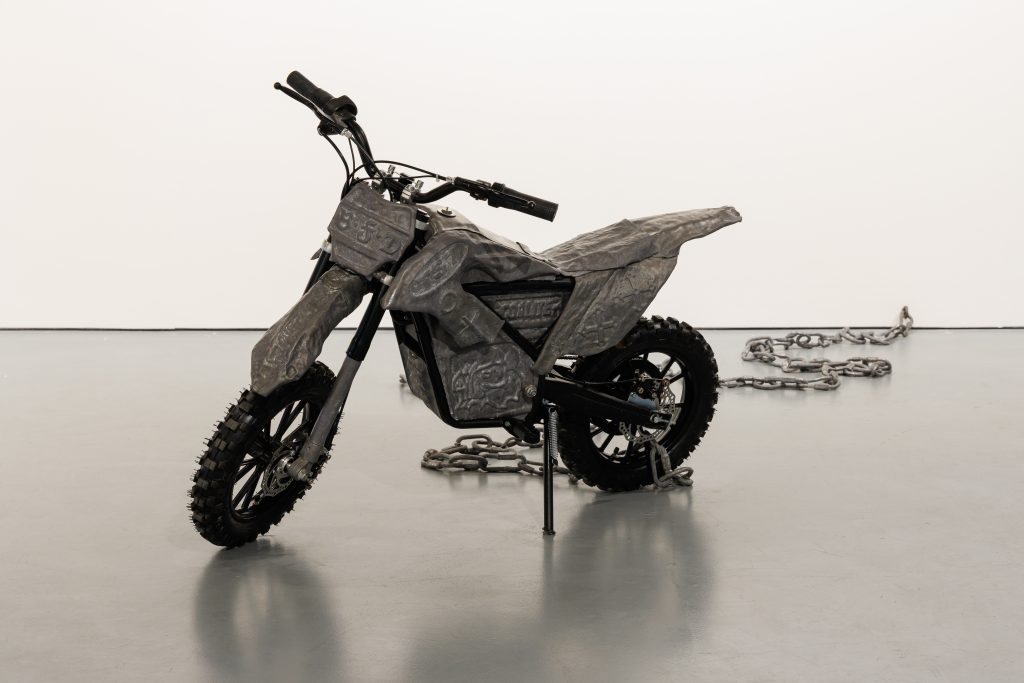
Liv Preston, Pit Bike, 2025, OUR TURN: Practice Bradford, Yorkshire Contemporary. Image Credit: Jules Lister
Though the artists were encouraged to create on their own terms, each piece feels deeply rooted in Bradford – its communities, histories and textures. This connection wasn’t planned, but emerged naturally through lived experiences and a shared sense of the city’s significance at this moment. Shown during Bradford’s City of Culture year, the exhibition carries weight and celebration. OUR TURN: Practice Bradford doesn’t just mark a cultural moment – it captures what it feels like to belong to a place in flux, and to be part of shaping what comes next.
***
‘OUR TURN: Practice Bradford’ is a free exhibition at Loading Bay, running from 18 September to 19 October 2025. For more information, visit the Bradford 2025 website.
The wider ‘Our Turn’ festival runs from 17th September 2025 to 28th January 2026, with exhibitions and events across the city. To find out more, visit the festival’s website.
Filed under: Art & Photography
Tagged with: Art Exhibition, artist, bradford 2025, Bradford City of Culture, Bradford Producing Hub, contemporary art, South square, Yorkshire contemporary
Comments