
Bradford 2025 youth team. Credit: Karol Wyszynski
A new op-ed from TSOTA’s Lead Editor Will, reflecting on the current value proposition the region’s creative sector is setting out for itself.
How do we define opportunity? And how do we know when we’re in a high-opportunity place?
For creatives or creative sector professionals, establishing a career and making meaningful early steps in the direction you want is not easy. It’s a lower-paid world, currently made worse by the economy and state funding squeezes; it’s competitive and demands that you build a portfolio before you’ve even begun properly working; you need to know your stuff and you need to know people and you need to be good at what you do.
But it’s a rewarding world, and a world always needing new talent. Those prepared for the challenge may wonder where a good place to start their career in culture is. Adobe, of all people, offer suggestions on the best cities for creatives to live in the UK, based on the number of museums, galleries, theatres and art schools, and the number of job openings recorded in each city. They conclude that the top four are Brighton, London, Edinburgh & Manchester.
Here are the things Adobe don’t take into account:
- Affordability and cost of living in these places
- Job market saturation in these places
- The richness and quality of the opportunities on offer
Of the least affordable cities to rent in the country, London is first, with Brighton third and Edinburgh sixth. Manchester is down in eighth place, but with rent increasing at a faster rate than anywhere else. London has the highest number of creative vacancies, but the competition relative to resident population is tighter, intensifying saturation for those in early-and mid-career stages.
Though the cities Adobe have put forward are amazing, among the best in the world for the volume of great culture, the ideal breeding ground for creatives and creative professionals needs more than high quantities of arts spaces: it requires lower costs of living, less competition, accessible scenes, and meaningful opportunities that offer progression and a chance to get platformed.
My theory: Leeds, Bradford and the surrounding West Yorkshire region get the right balance of opportunities and quality of life that you need to build a career. What I’ve seen in my time writing and working in this part of the world is that for those who want to make something, or promote artists, or put on events, or spark a movement, there are tangible pathways to doing so.
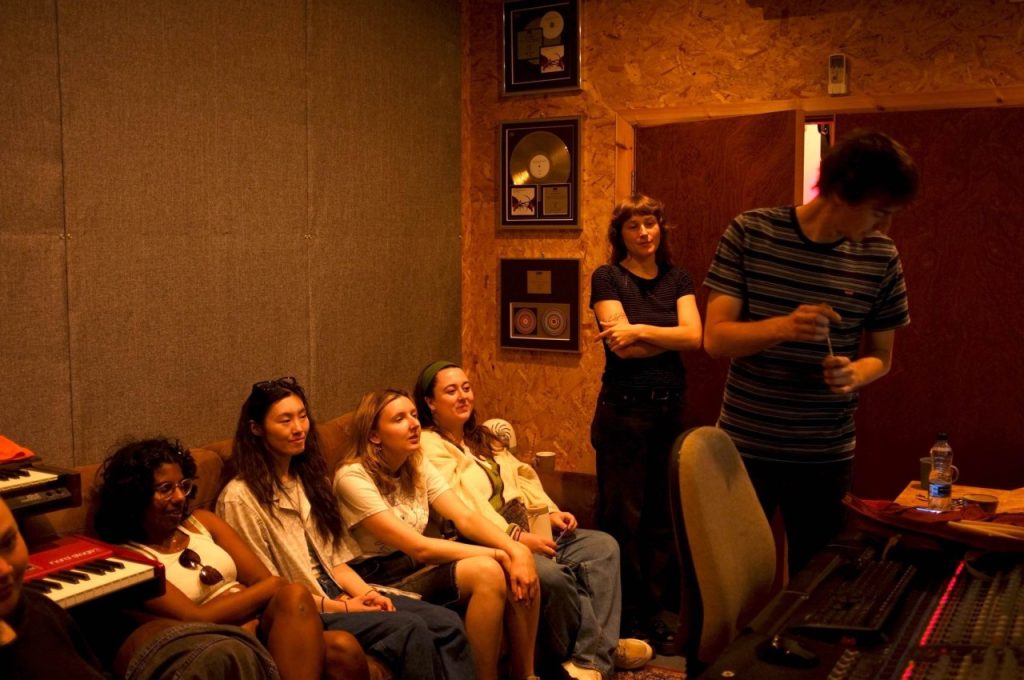
Eiger Studios. Photo: Lily Sturt-Bolshaw
Because the main thing West Yorkshire understands is that feeding the grassroots and developing people is just as important as the international programme or the mega-venue. Whilst the region itself hit record visitor numbers in 2025, it still feels that its specialism is in providing platforms and empowering people to grow from them – truly strengthening its ecosystem.
The data is starting to come in from Bradford’s year as UK City of Culture 2025. Over 5,500 individuals have benefitted from training, artist development, mentoring and paid work placements. 110+ grassroots groups received grants for activity, and youth engagement and skills programmes reached thousands of young people. These stats represent exposure to real work for people who might not have found it otherwise, and who are primed to continue building Bradford beyond 2025.
This is not a one-year phenomenon. Permanent organisations like Bradford Producing Hub, Come Play With Me, Launchpad, The Leap and Screen Yorkshire are consistently helping people access skills and start their professional journey.
Then there’s a cultural ecology beyond these entry points with space for people to perform, put on events, and learn in the process. For aspiring musicians and DJs, the grassroots circuit is extensive: The Trades Club in Hebden, The Grayston Unity in Halifax, Parish in Huddersfield, the 1 in 12 in Bradford. Clubs and nights like Cosmic Slop and Eiger. Radio platforms Sable, Alto and BCB. You end up with a holistic grassroots music industry where you can cut teeth from every angle.
And it’s not just music. We have the Northern School of Contemporary Dance, Phoenix and Yorkshire Dance producing the next generation of dance professionals. Left Bank, Hebden Open Studios, Dean Clough and the Art House showcasing local visual artists. For writers, Arvon, Hyde Park Book Club, the incoming National Poetry Centre. If you have skills or artistic talent, there will be somewhere that’s willing to host them, that can serve as an incubator whilst you refine them.
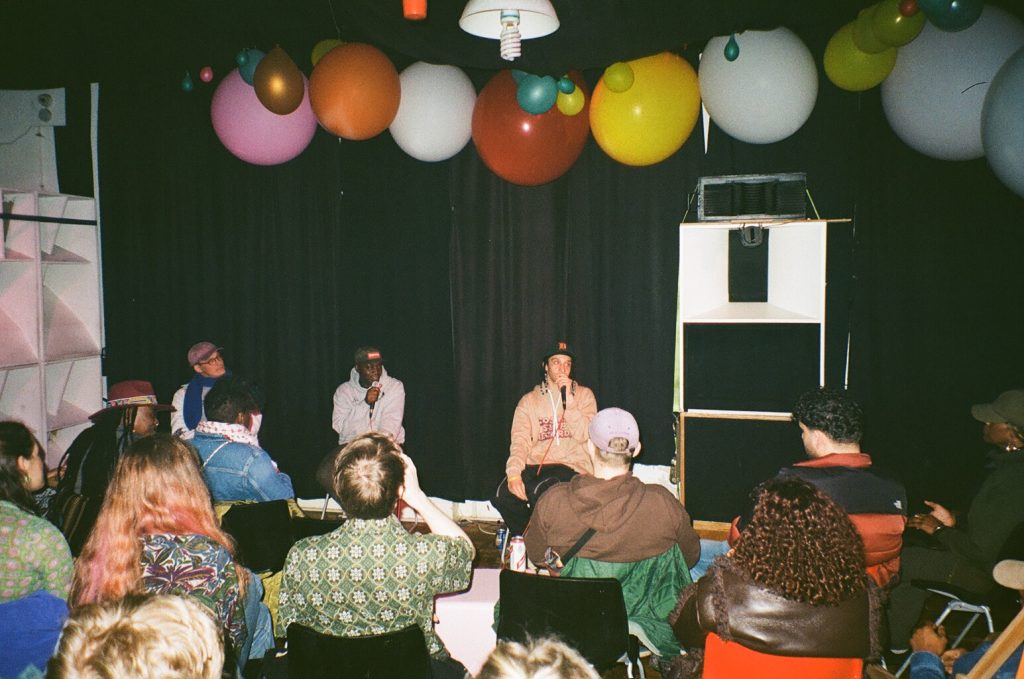
Cosmic Slop panel event. Credit: MAP Charity
Once you start getting into these circuits, cost of living matters. Average rents across West Yorkshire are far below those in London and the South East; Leeds and Bradford are among the most affordable large cities in the UK on a rent-to-income basis. This means less pressure to churn a wage just for rent, and more freedom to try things and take risks. Making it as an artist or arts professional is not meant to be easy, but it also shouldn’t mean working 60 hour weeks with no spare time to hone craft, just to cover the bills. Affordable living can be the difference between creative freedom and being indentured to jobs you don’t really want.
Proximity also matters. West Yorkshire is made up of smaller, closely acquainted creative sectors. Some may see this as a drawback, creating a ‘glass ceiling’ that ultimately leads talent to leave. But for those in earlier career stages, it means easier networking – and I don’t just mean ‘in the same email thread’ networking, I mean ‘having a beer and a chat at the same gig’ kind of networking. Strong connections are formed, with no more than a few degrees of separation from the role you want or the person you ought to know.
The region is also blessed with lots of smaller spaces run by smaller teams, doing disproportionately impactful things. In this tier, your contribution has higher value, and you are given more responsibility, earlier on. The creative industries are dominated by micro-businesses (about 90% with fewer than 10 employees), so jobs in big venues in big cultural hubs are competitive. Early-career roles in these settings are more likely to be short-term or freelance, with slower internal progression as a result. If you’re at the bottom of a big pile at the Southbank Centre or the V&A, you get to name drop them in your CV. But there’s a long line of others who want to take your place, should you give up, and progression will be slower.
And why does all this matter?
Well, without talent retention, the ecosystem falters. Leeds’ own Culture Strategy recognises that student transience is a problem: people don’t need to stay in one place forever, but a revolving-door system is a weaker foundation to build on. Presenting young talent with opportunity is how we’ll keep producing more Jasmine Myra’s, English Teacher’s, Saba Siddiqui’s, DJ Subaru’s, all the aspirational people I’ve met here who’ve stayed in West Yorkshire to deliver major festivals, run galleries, direct shows, tour widely, make good money from their art, and fuel the ecosystem.
Because West Yorkshire needs its own cultural value proposition – not competing on scale or spectacle with the Edinburghs and the Manchesters, but through offering density of culture without suffocation, where opportunity is viable and accessible.
Because when we commit to being a region of valuable grassroots opportunity, it strengthens the national sector, making artists, producers and ideas that travel. The alternative is a bottlenecked country, where talent competes for diminishing space in a handful of cities, while potential elsewhere goes underused.
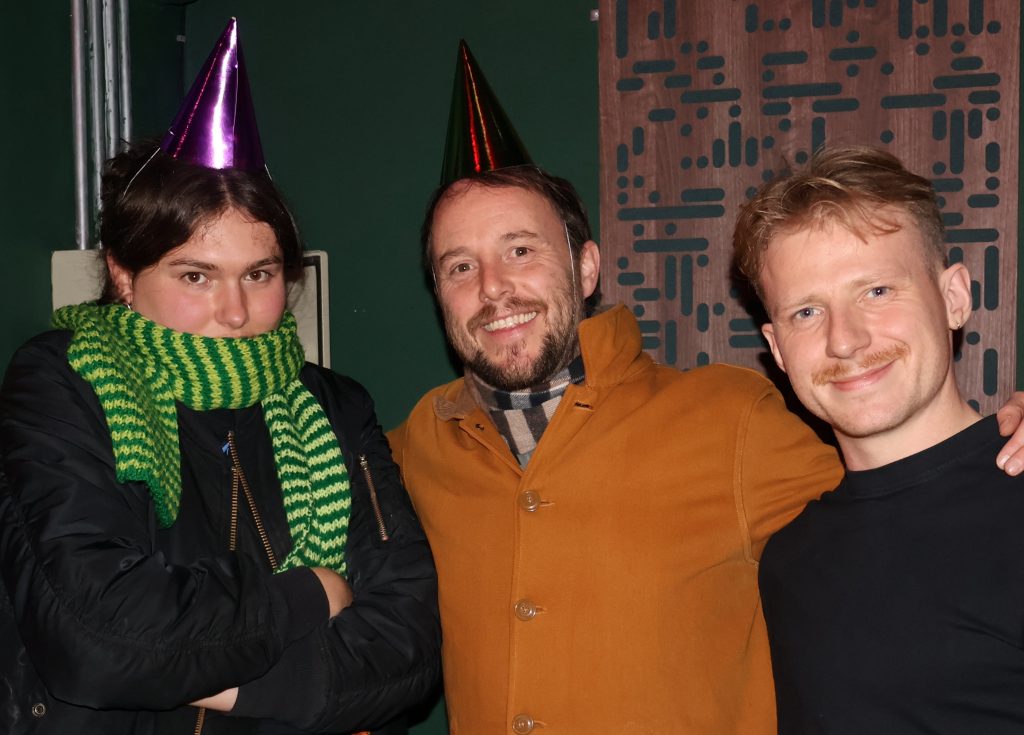
Holding Patterns team. From l-r: DJ Subaru, Jack Simpson, Will Baldwin-Pask
The minimum responsibility for all of us that work in culture, from FOH to the comms teams to the universities, is to help turn our towns and cities into great places to live. We have to make them colourful, inclusive, entertaining places. But we also have a further responsibility to be positive about them, to tell a story about ourselves that inspires, that makes everyone proud.
We need to encourage people not just to work in the creative industries, in the face of all its challenges, but to do so here in West Yorkshire. If we allow the definition of opportunity and opportunity-high places to be just about volume and size, then we risk underselling ourselves. By making the case that opportunity is about the richness of experience, the freedom of a lower-stress lifestyle, that it’s about better bang for buck, open doors, valuable platforms and caring, career-building communities, then we start to win the argument.
Opportunity isn’t always an abstract or an ideal. It’s not just a buzzword. In West Yorkshire, it’s real: and that’s a narrative we must keep pushing.
Filed under: Comment
Tagged with: Bradford, bradford 2025, Bradford culture, grassroots, leeds, leeds culture, music, West Yorkshire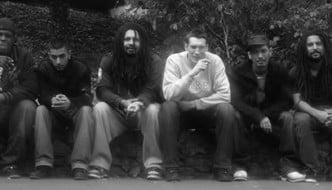

Comments