William Blake Remixed: Testament and Matthew Bourne Bring a Visionary Poet into the Present – Review
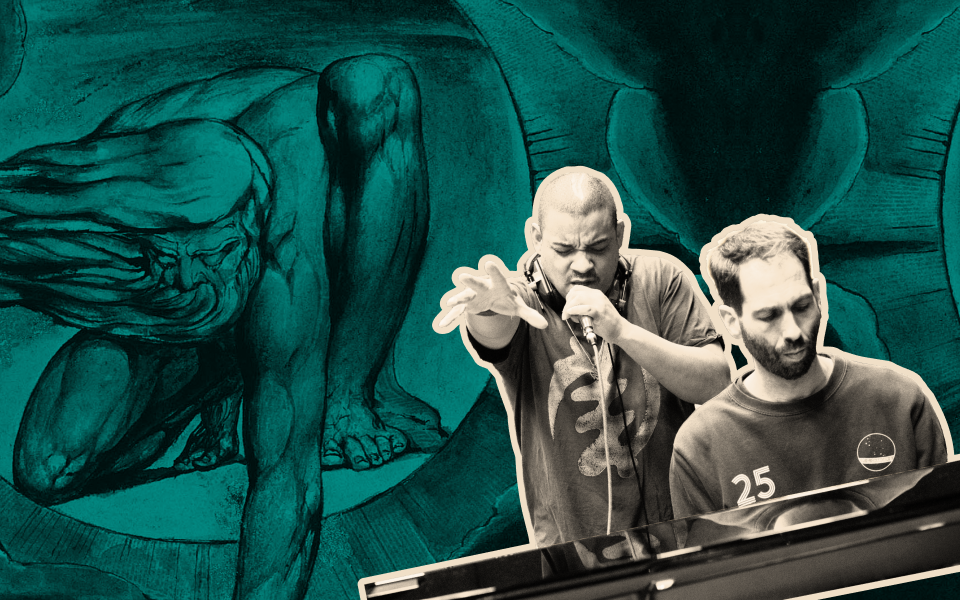
Image Credit: Mister Giles.
At the end of April, thanks to the immense Leon the Pig Farmer’s recommendation, I got to do a gig at the Brudenell. Even though it was only a support slot, it was obviously very exciting but also daunting, because the main act was the cult Sheffield parody band The Everly Pregnant Brothers, and my stuff ain’t funny. How do you make serious poetry appeal to a crowd who have come out to be entertained?
The more I thought about it, the more nervous I got, but I came up with a plan. I would ask if anyone in the crowd hated poetry, and then I would try to strike up a rapport with them and have a bit of fun at least trying to “convert” them. Luckily, on the night a hand went up. It belonged to Max, 16 years old, and I told him I would check in with him after every poem. With him the focus, his reactions got more positive with each one and, to the delight of the crowd, he admitted after the last one that it had been “reet good”. Afterwards, I went up to where he was sitting with his Mum and Dad, and he said the reason he hated poetry was that the stuff he learned in English was “boring”. I sympathised, and gave him some recommendations of contemporary poets he might like.
This is a huge problem. Our education system does not seem to value poetry anything like enough, and certainly not the sort of contemporary poetry youngsters are likely to enjoy. This does not mean they should not also be learning the great poets from the past, far from it. Poetry is an ongoing conversation with thousands of years of history behind it, but if we are not placing the past in conversation with the present, we are just preserving an old art in aspic, whereas poetry must always be innovative. We need visionaries.
Testament and Matthew Bourne. Image Credit: Lucy Gwen Williams.
The words “Blakeian” and “visionary” are practically synonymous in poetry. Unlike most of the Romantic poets, William Blake lived cheek-by-jowl with the common populace (in the heart of London) and produced truly radical work. He didn’t simply stand in opposition to the problematic aspects of the Enlightenment, which was largely white-supremacist and patriarchal, but burrowed deep within it and produced important internal critiques. Later, John Clare, like Blake not hugely regarded in his own life-time, explored our landscapes and highlighted the deep social inequities that had shaped it. Both writers overlapped with Wordsworth, who famously had the time and the privilege to ponce about the Lake District rhapsodising about the daffodils most of his country-folk did not have the leisure to enjoy.
Today, Testament (like me, a Londoner in exile in Yorkshire) is also a visionary, egalitarian and multi-disciplinarian just like Blake. As a young lad, Testament was inspired by Blake, finding parallels within his own life which have only developed and strengthened as he’s got older. Now in his late 40s, he has the long view that enables him to tackle both parts of ‘Songs of Innocence and Experience’ equally well. He is actually about a decade older than Blake was when he published them, but it turns out he first tackled this material a decade ago when he was roughly the same age (and The State of the Arts was there!)
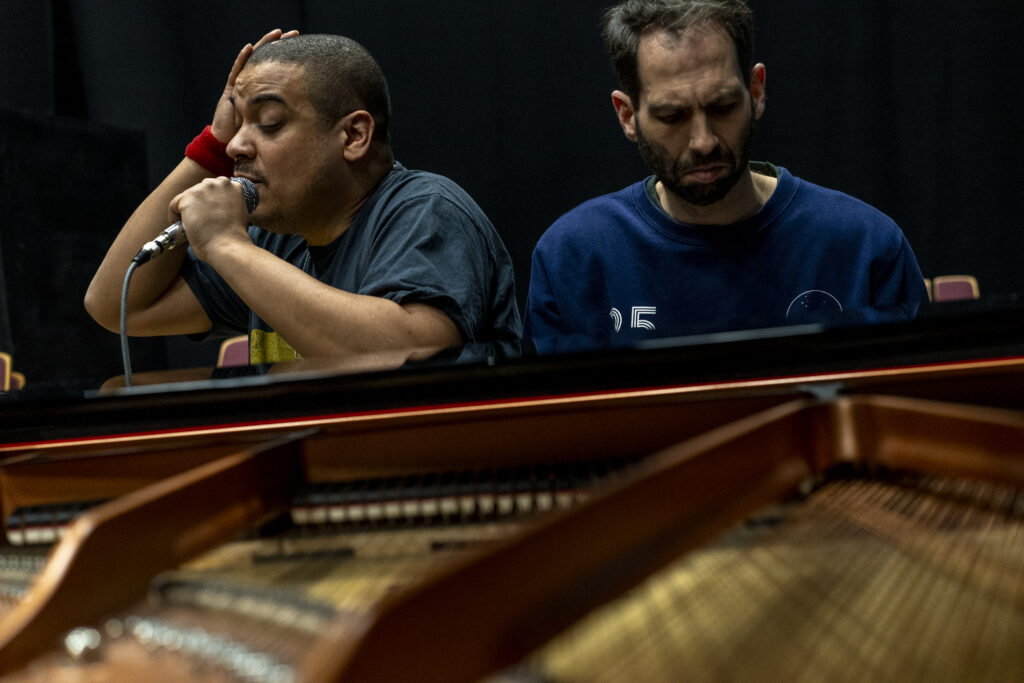
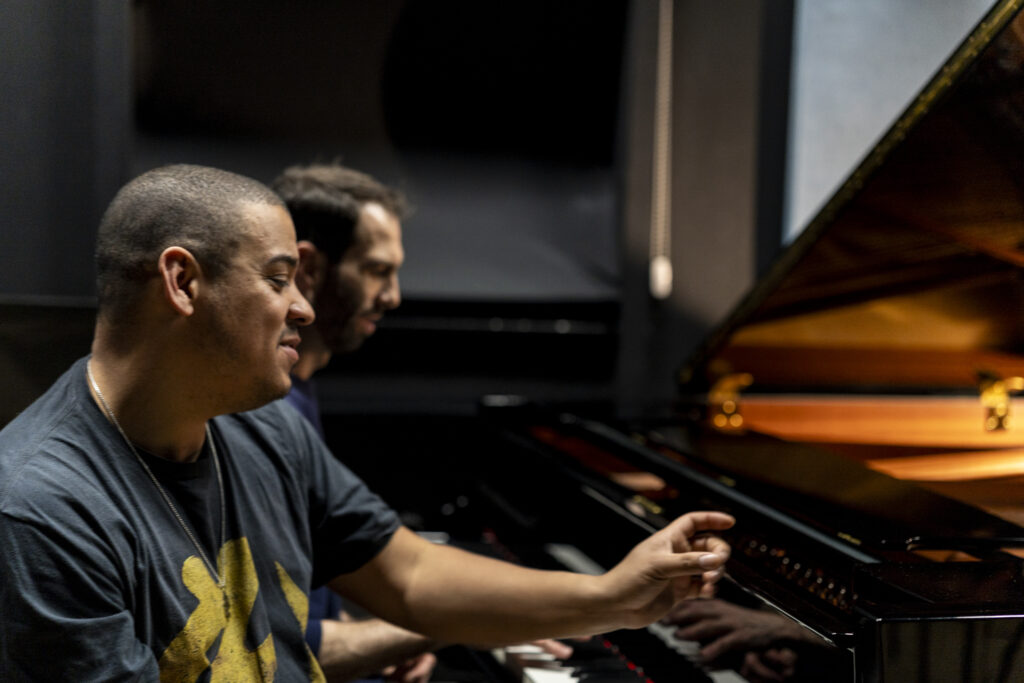
This is very much Testament’s show, but he knows how to surround himself with the right people to realise his vision. Matthew Bourne’s lush, haunting soundscapes and tense piano are the perfect accompaniment to Testament’s virtuoso undulations between lilting recital, vocal loops and explosive yet perfectly-controlled beatboxing. Digital versions of Blake’s extraordinary visual art, as well as graffiti art and moving images, form a disturbing but exquisite backdrop.
Testament and Matthew Bourne. Image Credit: Lucy Gwen Williams.
His old university pal Corinne Bailey Rae reminded us all that whatever her genius as a song-writer, her vocal prowess stands alone as an artistic expression, and the emotional impact of her interpretations of the material were no doubt charged by the scars of the tragedies she has borne in her personal life.
For me, however, the real revelation of the show was the extraordinary Far Cry Acapella community choir from Huddersfield. Led by Jenny Goodman, they sent Blake’s words soaring over us, including a beautifully counter-cultural version of ‘Jerusalem’, removing the controversial imperialist sweep of the anthem with which we are all so familiar. But the words they made the toughest to turn a dry eye to were not those of Blake, but those of Jim Woodland. Their rendition of his ‘The Luddite’, arranged by Janet Russell, was for me the most rousing number of an extraordinary night, perhaps because it reminded us that Blake was on the side of ordinary folk.
And of course, there were the Blake poems themselves. Starting with the ‘Introduction to Songs of Innocence’, when “on a cloud I saw a child” and taking us through the heart-rending ‘The Echoing Green’, the duality (and, in this version, what felt like the inner turmoil) of ‘The Tyger’ and onto the greater experience and wisdom of ‘The Poison Tree’ (which reminded me of an old Maya Angelou telling a young Dave Chappelle “You must be angry…but never bitter”), the weary caution against repression of desire in ‘The Sick Rose’ and my personal favourite, ‘The Four Zoas’, in which Blake – Testament – points out that “it is an easy thing to rejoice in the tents of prosperity”, which brings me straight back to Wordsworth and his bloomin’ daffodils!
Had I come to Testament and Matt’s show before the Brudenell gig, I would probably still have given Max some pointers to contemporary poets, but I would also have reminded him that some of the old, dead ones remain relevant today, both through their own genius, and through the genius of the living people who love and re-interpret them with such vision and passion. Like Testament.
***
Far Cry Acapella will be performing with Testament at the North Of England Centre for Music and Arts in Marsden on 12 July 2026 at 4pm: https://www.ticketsource.com/necma/one-heart-many-beats-far-cry-acapella-and-testament/e-kkprbo
Filed under: Poetry
Tagged with: Brudenell, City Varieties Music Hall, corinne bailey rae, innovation, Keith Fenton, Matthew Bourne, poetry, songs of innocence and experience, Testament, william blake

Comments