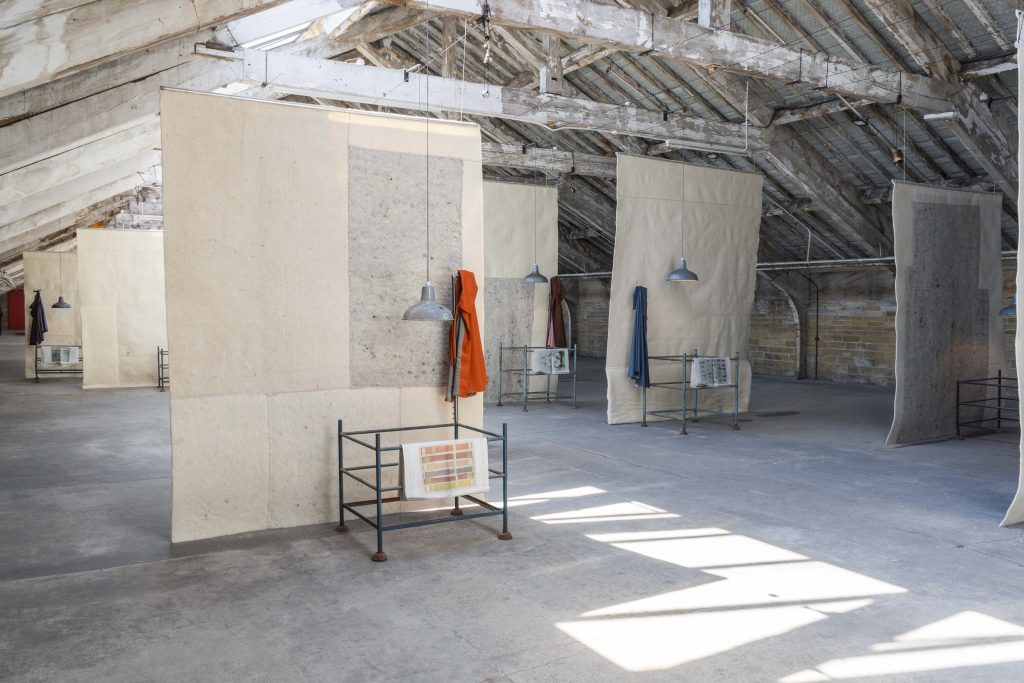
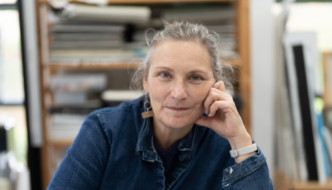
Normandie Room. Image Credit: Ann Hamilton Studios.
Do you believe in fate?
The whole project was fated in an uncanny and bizarre way that could never have been orchestrated.
It’s been a serendipitous journey.
Yes.
I’ve been reading about it – about you happening to be here on holiday exactly a year after the first email, when the announcement was made…
The day the announcement was made…
…And also happened to be in the back of a Japanese cab?
I was in a pub…
…a pub?
…I was in a pub
Oh, I had read about a Japanese taxi-driver who had been doing something here, maybe someone gave me a bad lead there…?
Ah, you know what that story is…? I was in Japan, working on another project. We were on a train, going quite far, and we had not reserved seats. She called her student, who she knew was teaching near the next stop, and said “are you done teaching, can you drive us there?” So he gets out of class, meets us at the station, and he drives us there. He’s an artist, and I’m in the back seat, and there’s some books there. One of them was from the show that Jen [Hallam] and June [Hill] curated here at Salts Mill. So this is a Japanese artist, I’m in Japan, I’m having this conversation with Salts Mill, and this book is in the back seat. That’s fate, right?
It’s very difficult to argue against the existence of fate when you hear a story like that. But then also Bradford became the City of Culture…
Yes, and it was just a speculative “are you interested?” “if this happens…” and then it…happened
Well, yeah, and then here’s the thing… There have been several Cities of Culture, and Bradford is just one of them, but it appears Bradford’s is particularly, what this says (I show her the Rotherham anthology) ‘Ourselves Reflected Back’. As a part of the local creative community, we look up, and it turns out that up there, it is people we know who are on stage…
Yes…
…That doesn’t mean they don’t bring people in from abroad, but this is something really important, anyway I’ll come back to community a bit later…
Now, I’m just acknowledging the fact that you expressed your thanks to everyone, readers like me, volunteers, and all the rest of it, but I would also like to say it’s been a great privilege to do this and be involved. I felt as a reader, and we are in the very place I was reading, my voice travelling through this space, and I also felt there were certain things that worked better than others. Did you have a moment when you thought “I’m going to have sound here, and some of it is going to be driven by community elements, which are not going to be curated. Did you have a feel for the kind of sounds they would be pushing through…?
I think I was much clearer about the recorded sound, you know the permanent part. When I think about the space and imagine it in plan, it’s like an I, with a long top and a shorter bottom. I think of those two end rooms, the canal and the spinning-room, as the ears of the piece, and then this little booth, which was probably a manager’s office of some sort. I remember thinking how anomalous it was, that it was here in this vast room, and then slowly over time, I started thinking about how the third voice of the piece needs to be this voice that’s changing. We were actually here for one of the site visits when this technical director for BD25 read a letter from one of the students at Heaton St Barnabas, which is in this book, and we were all just moved, so much.
From then, I thought if sound is how we touch at a distance, for example a letter touches from a distance, I wanted to have the intimacy of that kind of presence. That is what the booth allowed. You’re in the space, but you’re not, you’re open because the windows are actually open, but you’re not really performing, you’re reading out loud for yourself as much as you’re reading to the images in front of you.
When it first opened, I was sitting over there with June, hearing the sound of the spinning, whistling, and humming of Emily Eagen. I could just barely hear the sound of the records at the other end when the chorus came on, but I was with the voice reading which was a different cadence. When those three things weaved together I realised that that moment was actually the piece, but we didn’t really know how we were going to repeat this process or invite people in. Really it was June, over there lurking in the shadows, who really took it on. June began to feel the possibility of what could happen around us, and slowly through word of mouth people started volunteering and finding satisfaction in being here in this way.
So, I’ll come to community – that’s my 5th question coming up, but the next sort of thing I’d like to look at is part of that. You brought in people who are very good at what they do, to help, so we’ve just said goodbye to Dave Crickmore, for example, who has wonderful ears…
Yes, he does…
…And I think you said in Ali’s film, he has a great deal of patience, and all the rest of it. There’s also Emily Eagen, who I haven’t met… is she someone with whom you have collaborated before, or did you find her?
This is the second time we have collaborated. The third time really. I met her a decade ago, when she was singing in another piece. When I was beginning a project a couple of years ago I remembered, “oh there was this amazing woman who was a world, or national, whistling champion.” I got in touch with her and this has started a whole series of projects for both of us.
Well, of course, I have become familiar with her voice…
Yeah…
When you made decisions about who to take on, I guess you’d already made a decision by collaborating with Emily before, but someone like Dave, was he new to you?
Really I think June should come in here because a piece is made by so many different levels of finding. I think the good intuition of the curators were finding people whose heart and sensibility would be something we could work with.
We didn’t always really have a specific question so we needed people we could have a process with. Finding Ali, Hobbs, the film-maker, David Crickmore, Sian Thomas, and the team that Bradford 2025 brought in – this great group of people helped bring this thing, that we didn’t know quite what it was yet, into existence. I think it’s really important to say how much the piece evolved out of conversation, and recognition of what was happening in front of us. That’s continued through to the last moments. For example, finding out there was a rainbow over Hope Hill and that the window in the canal space was open to Hope Hill, which we never knew was its name… just brought the piece full-circle.
A lot of what we talk about in this space is the future… The book in front of us is called ‘Letters to the Future’ and I think in the film that Ali made, you’re wearing something with The Future written on it?
Yes, it’s here [on the desk in the booth]! That’s the last one that exists…
So, I want to talk about the future and just come back to the past, because I believe you did an installation in China 30-odd years ago, called Lineament?
Lineament was in, er, it was in California…
Oh it was in California… I beg your pardon. But it’s based on a Wallace Stevens poem [The Planet on the Table] and that word, Lineament, is in it. It’s interesting to me as…
…As a poet…
… A poet, yes, because I’m looking at that poem and you’ve only taken one word out of it. I never saw the installation, but in the poem Ariel, the poet…
Yes…
…Is writing his things and they are temporary, transient, and they don’t speak necessarily to the future. He also says that things are made by the sun, which is reality, and things are made by the imagination, which is his, but all these things have the same heft. That’s interesting because he’s not looking at a future, whereas you definitely are looking at a future. So, I wondered if there was a dichotomy there, or whether it’s part of the same thinking process, in terms of what the future is, and how important the future is to us?
We’re in the future now, from our drinks earlier. But when we’re thinking about this book we’re also probably thinking about some time when we’re all gone. In terms of the Ariels of this world, they seem to me still to be very important in and of themselves. However, does the fact that we still think about the future mean that paradoxically we will always have a memory of Ariel’s poems, and, therefore, Ariel’s poems, unlike in the thing [the poem], actually always do speak to the future?
Yes.
Yes, hahahaha…
Hahahaha…
Well, that was supposed to be a short question and a long answer, but it went the wrong way round. I’m very sorry about that! But, yeah… is memory itself the ultimate gift to the future, I suppose is what I’m asking? Is that what we’re giving the future?
Yeah, I think it is. For me, the future is the sense of possibility, that things can always transform. If we recognise that we’re part of the future then every act is an act of making because it participates in making the possibility of the future. That obviously always includes the past. So we’re both – just like we have two hands [stretches each arm out away from here 180 degrees]. I think in some ways we’re like the 15th century and the 31st century. Thinking about your own presence within that kind of timescale highlights the responsibility of making in the world.
One of the books that I read, which I bought in the Salts bookstore, is by Russian writer Maria Stepanova. In one section, she writes about what happens to objects when the person to whom they had a very specific visceral tactile memory, is no longer here. This question has haunted me through all this, and I think it has something to do with things staying. Things stay alive because they’re also passed on and given away. I think part of the ephemerality of this piece is this moment in time. What’s important is not to hold onto it, but actually to let it go, and how we let it go is also part of what it is. I don’t know if that’s an answer or not…
No, it is. A wonderful answer. There’s a lovely piece in Ali’s film, that accompanies this exhibition, where you’re in the spinning-room, just behind us. You clap [I clap] and you get a much bigger echo than I did (just then). I paused the film at that point and it looked like you were kind of in supplication… to the air. You also seemed to be cradling this piece of air, like it was a microcosm of the air around it. Like it was the essence of what you’re now going to use to drive this project. Do you have a memory of that first visit to that space…?
I do.
And what did you think when you saw it? Was there light coming through, or was it dark…?
It was a beautiful day… is that your memory, June? I was here very briefly, and the first thing we did was walk the length and try to listen to the sound from one end to the other, and what that kick-back was…
[fireworks go off outside, and we laugh at how fitting it is]…
…I think that the space gives you the piece in many ways. You have to work with what it is, and I just thought that was so clear from the beginning, that it was sound that would hold it.
And the light from them skylights, coming through the rafters…
…The way it makes a path of light…
…And the warp and weft to that light. I guess you must have thought “this is it.” I asked you if you believed in fate, but do you believe in ghosts? It was Halloween when I first met you, when lots of people write frivolous stories about ghosts. When we talk about ghosts, we may think of something with a sheet over its head walking through walls, but you may think of spaces like this…
Certainly the building is saturated, not a ghost, but it’s haunted. Or not haunted, but it holds everything that ever happened here so that it is here, whether visually or anything. I think our social history often haunts present circumstances in a way that we really need to address. I think until we actually address that haunting, then maybe we can’t move forward… I’m thinking about the political situation in the country where I live…
Yeah…
…So, not ghosts, but hauntings, perhaps.
Hauntings… how things repeat over time, just like weaving repeats and repeats…
I mean, this whole thing is a weaving…
Yeah, the whole thing brings everything together. You were talking about sound as being the primary driver that makes it, or is it really images, or the architecture…
…It’s all twined together, you can’t really separate it now…
…Interlinked. There’s a couple of things there: as artists we often work alone, but how important is community to the artistic process?
I don’t set out intending to make a piece inviting collaboration with the community, that’s not where I start. I start by asking what is a piece, what does a project need to be? And then I think organically from that, which actually brings in ways of participating and collaborating. The piece unfolds through conversations, and is responsive to them, and a part of that forms the project. Then there are really direct collaborations, like with the records. I think my biggest question when starting is how do you invite people to just be with something? Then, what is the way that this project can do that? That actually allows people to enter on their own, and in different ways, and I think that’s what happened with the reading-booth.
When we look at the project now it has finished…
…Yeah…
…you said you’re gonna give bits of cloth to people who come and volunteer tomorrow. Maybe we’ll also find a home for some of the letters, and things like that…
…mm-mm…
…maybe you could use some of the cloth to bind some books. The final question really is… When you look at the physical legacy of the project, what’s going to happen to those, for example [pointing at the big woollen fèves]?
I’ll tell you what’s going to happen to them…
…Yeah, go on!
We’ve talked to Dawson’s, whose felt is on the back of all these images, and I asked if they can hang them in their warehouse.
Wonderful!
So they will be there.
And then the abstract legacy. The idea that people will still remember all this after it’s gone and dismantled. Do we have an outlet for that, do you think? Or are we still thinking about what that might look like?
The letters could become a book that can be shared in another form. I also think that everyone carries away their own experience. For example, one of the readers was telling me about a group they’re forming…
…Yeah…
…To continue reading…
…That’s us!
That’s you?
Yeah! Mary has just put us in the group – that’s a legacy.
…That’s a legacy. Or, there was a group of Urdu-speaking women who read from memory in the booth and now they’re writing.
Wonderful!
You can’t determine any of that, and you don’t want to. But what you hope is that it seeds the possibility.
Exactly! Well, I have to say that I have met lots of wonderful people from embarking on this project with you. A small legacy is that you brought people within Yorkshire together, even though you came a long way to do it…
…and that wasn’t my intention. I think that’s really important to understand. That is what the piece needed so it kind of grew on its own. It’s fate?
…It’s fate!
Is that where we end up?!
We started with fate, and we’ll end with fate, and legacy, which is a kind of fate. It only remains for me to say… Ann, thank you very much for enlivening this space with such beautiful, communal art, and for bringing so many people together. We all just feel a bit brighter and happier for having been part of it.
And me too…
…And you too! Thank you very much indeed for everything.
***
Thanks to Ann for chatting with TSOTA! For more information on ‘We Will Sing’ read Keith’s review here.
Filed under: Art & Photography
Tagged with: Ann Hamilton, art, Art Exhibition, Bradford, bradford 2025, Bradford City of Culture, City of Culture, Fate, haunting, legacy, Salt’s Mill, We Will Sing
Comments