Writing the North: Does Catharsis Have a Place in the Arts? – Column

Keith performing poetry.
Welcome to our new columnist, Keith Fenton, a Leeds-based performance poet, broadcaster and host of Poets Talking Bollocks podcast. Each month he will be writing about the events, people and debates which are shaping literary culture in the North.
An English poetry festival, February 2025: a brilliant poet, whose collection I own and adore, has just given a magnificent reading and is now talking about poetic responses to grief and trauma. I am listening intently, but then she says something which I recognise as true yet also jars. “Poetry is not catharsis,” she says, and then, in case the significance was lost, “it is never catharsis.”
Let’s start with why this is true. Making great art is not merely a matter of expressing your feelings. In ‘How to Write It,’ Anthony Anaxagorou has a section entitled ‘Poetry is More Than an Outpouring’ where he talks about how his devastation at the death of an uncle did not lead to great writing on his part: “My ideas had no real form or shape… I realise now this was more about catharsis than literary innovation.” Contrast this with an early Simon Armitage poem on grief, ‘Gone’ – at the time at least, he had not suffered the bereavement he describes. Likewise, my friend Tim Brookes’ poem Folded Page Corners (from his collection ‘Keep Taking Six Away from 100’ – Yaffle Press) engages with the loss of his mother some years before it actually happened. Yet, it puts an instant lump in my throat every time I hear it. A poem need not be literally true for it to speak a higher truth than reality. And even when the events in a poem really did happen, it will not become a great poem without skill honed over a number of years, just as with any other art.
Nevertheless, for many of us in our grassroots community, in Leeds, in West Yorkshire but also more generally across the North of England, the more direct poetry is joining the dots and connecting more people, drawing more people into our community. And that, despite my own commitment to improvement in my own practice, is what I am most passionate about. The monthly event I run with Aqeel Parvez in Leeds, Poets Talking Bollocks Presents (a spin-off from the Poets Talking Bollocks podcast), attracts poets of all levels of attainment and experience, from top operators to recreational poets who simply enjoy sharing words and have never sought to go beyond that. Then there are the people who are quite new to this performing lark, who – perhaps having been through a rough passage in their lives or because of life being chronically rough – have finally turned to poetry.
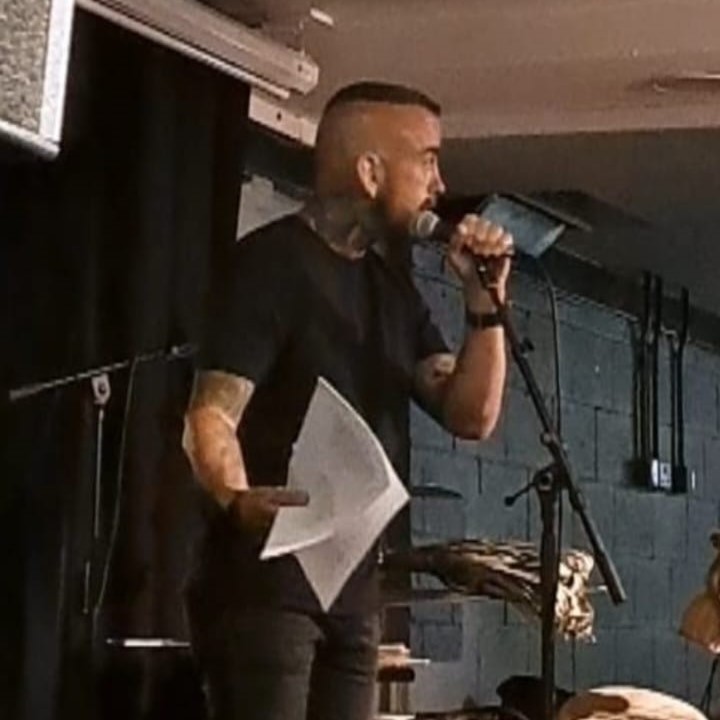
Steve performing poetry.
These are the cathartic poets, and while for some it may only be a stage en route to a higher poetic practice, it is surely an important stage and, perhaps even more importantly, of huge value in its own right? And surely it is still poetry, and therefore poetry can be cathartic? Just as my turning out occasionally for a social cricket team is still me playing cricket, even though I’m nowhere near good enough to play at Test level, these are still poets and they have a place at the table. And, while their poetry tends to be more direct and less orbital, it connects and resonates and inspires, and has real world outcomes.
Steve, for example, is writing – and powerfully performing – hundreds of poems, leaning into complex PTSD arising from military service, his experience of prison, addiction issues and isolation. In doing so, he has not only addressed some of his own demons and given himself a purpose in life and a community, but has also put himself in a position to help other men avoid the pitfalls to which he fell victim so often. Not that it is only men he inspires. He has formed strong bonds with some of the women writing and performing cathartically on our circuit, such as Sarah, who comes to this from 32 years of domestic abuse across two marriages – her performances are powerful, defiant and rousing, but this is not all. She has inspired other women not to settle for poor treatment in their own relationships and given hope to women who have felt trapped like her. In March we had a debutant at Poets Talking Bollocks Presents who was so moved by Sarah’s short set that she began to examine her own relationship with her partner of 16 years and when we reconvened the following month, she used a little of her time at the mic to tell us that she had become aware because of Sarah’s set that her partner was a coercive controller, and that she had since kicked him out of her home and her life.
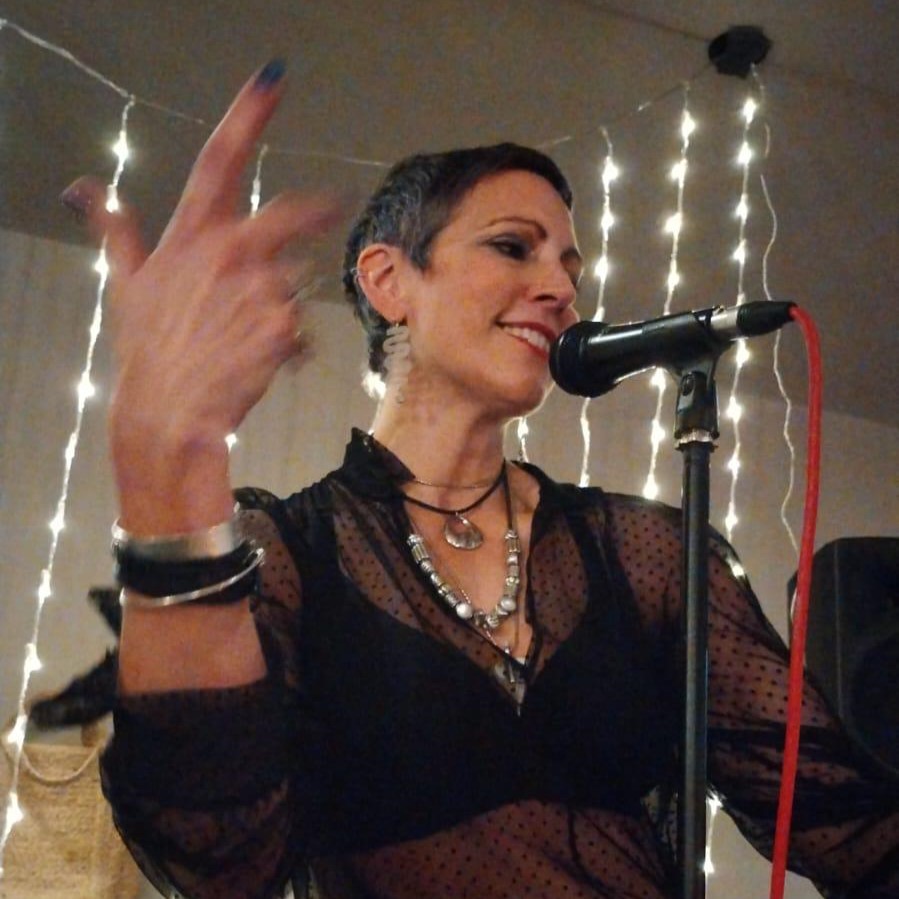
Sarah performing poetry.
When cathartic poetry can produce radical action of this sort, it shows how hugely important and connective it can be. Steve and Sarah and many others like them, are improving all the time, and they know they have the option of moving up the gears into serious poetic practice. If that happens, catharsis will have been an important stage on that journey, and even if that doesn’t happen, their work will continue to have intrinsic value. Beyond this, Steve has already set up his own events, and Sarah has helped set up an all-female spoken-word collective called That’s What She Said, whose first gig will be at Hyde Park Book Club on 15 June 2025. I expect the poetry to be chiefly of the cathartic variety, and I expect all of us who attend – male and female – to come away with a better understanding of the world for having gone.
***
You can catch Sarah’s event at Hyde Park Book Club on 15 June at 17:30 and buy tickets here. You can keep up to date with Poets Talking Bollocks on their instagram page and catch their monthly Sunday afternoon open mic event at The Chemic Tavern, doors 2.15pm.
Filed under: Poetry
Tagged with: catharsis, Chemic Tavern, leeds, poetry, poets, Poets Talking Bollocks, spoken word, Writing the North


Comments