
Reimagining Justice: The Court for Intergenerational Climate Crimes at Leeds Arts University – Article

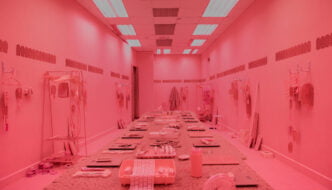
Radha D’Souza and Jonas Staal, Court for Intergenerational Climate Crimes: British East India Company on Trial, 2025. Commissioned and produced by Serpentine Galleries Ecologies. Blenheim Walk Gallery, Leeds Arts University. Photo: Jules Lister.
The Court for Intergenerational Climate Crimes (CICC): The British East India Company on Trial is an immersive installation by artist Jonas Staal and lawyer-activist Radha D’Souza. Having toured internationally, it now arrives in the North of England for the first time, transforming Blenheim Walk Gallery at Leeds Arts University into a tribunal. Here, the British East India Company is symbolically put on trial for its historical ecological impact and environmental destruction, with visitors invited to cast their votes as part of the proceedings. TSOTA visited the exhibition and spoke with Dr. Marianna Tsionki, curator of the Leeds presentation, about adapting this ambitious project for a new space and audience.
The CICC first launched in 2021 at Framer Framed, Amsterdam, focusing on Dutch-registered corporations such as Unilever, ING, and Airbus, and interrogating the legal frameworks established by the Dutch state that sustain corporate power and ecological exploitation. Since then, the project has toured widely, with different iterations presented at Kunsthalle Münster (Germany), Kansalaistori Square (Finland), Oil Tank Culture Park (South Korea), Ambika P3 (London). Each new site reimagines the exhibition within different local contexts, both spatially and politically.

Court for Intergenerational Climate Crimes, 2021. Radha D’Souza and Jonas Staal. Commissioned and produced by Framer Framed, Amsterdam. Photo: Ruben Hamelink.
Marianna described the process of reshaping the installation for Leeds Arts University’s more intimate gallery setting. “You can see from the film that when the work was first commissioned, it was presented in a much larger space,” she explains. “I was a bit worried initially because our space is smaller, but we worked closely with the artists, and I think they’ve done an amazing job in adapting the installation to the needs of the gallery.”
One key change in the Leeds edition is the location of the hearing itself. “The hearing would normally take place within the installation,” Marianna continues, “activating the relationship between the artwork and the city. But in this case, it would have limited the number of people able to attend. So we decided to host the hearing in an auditorium, still very much referencing the installation – a point where the legal and the artistic intersect.”

Radha D’Souza and Jonas Staal, Court for Intergenerational Climate Crimes: British East India Company on Trial, 2025. Commissioned and produced by Serpentine Galleries Ecologies. Blenheim Walk Gallery, Leeds Arts University. Photo: Jules Lister.
This separation subtly shifts the experience. In the auditorium, the discussion of colonial and environmental legacies feels formal, intellectual, and emotionally intense. Stepping into the calmer, contemplative space of the gallery – bathed in the warm yellow glow of lightboxes that cast botanical shadows across the walls – offers a moment to breathe, reflect, and imagine how we might rebuild our relationship with the non-human world.
Although the design and concept originate with D’Souza and Staal, Marianna emphasises her role in fostering this reflective environment for dialogue and discovery. “As a university gallery, research and critical conversations are at the core of our programming,” she explains. “We wanted to create a multi-layered approach where visitors can engage briefly if they only have a few minutes, or spend time delving into the deeper research behind the project — from legal theory to environmental justice. I hope it strikes a balance between learning something new and being in a thoughtful art environment.”

Portrait of Radha D’Souza and Jonas Staal. Photo Ruben Hamelink, 2021.
This is the first time that the exhibition has come to the North of England and Marianna highlights the importance of its arrival in Leeds. “Very often these sorts of productions never travel outside London,” she says, “creating accessibility issues and a centralised approach to arts and culture. I’m very happy that the artists share our commitment to reaching beyond the metropolis and engaging with the North.”
Leeds, she notes, is particularly fitting as a site of reflection on the British East India Company’s legacy. During the hearing, D’Souza traced historical links between Leeds and the Company, including the Yorkshire elites who profited from its trade, such as the owners of Harewood House. “This gives us the opportunity to engage not only with our student and academic community, but also with the city’s diverse populations — including communities directly impacted by colonial histories. It’s an opening for all of us to think critically about how past injustices shape current social and ecological inequalities.”
“Uncovering this history helps us understand that there is a continuum,” Marianna reflects, “that things don’t just appear from nowhere. It helps identify who is truly responsible for this ongoing crisis.”

Radha D’Souza and Jonas Staal, Court for Intergenerational Climate Crimes: British East India Company on Trial, 2025. Commissioned and produced by Serpentine Galleries Ecologies. Blenheim Walk Gallery, Leeds Arts University. Photo: Jules Lister.
In many ways, the CICC is a radical project. It reframes the climate conversation by recognising non-human agency and the suffering of the more-than-human world. This idea is beautifully embodied in the installation’s collection of illuminated lightboxes, each displaying botanical specimens linked to the ecological consequences of the East India Company’s activities. Developed in collaboration with Kew Gardens, these works invite viewers to consider plants and ecosystems not as passive resources but as witnesses and voices in the story of climate injustice.
“This is one of the most important parts of the project,” Marianna explains, “because it marks a huge shift in how we understand who is really affected by climate change — which, of course, is the non-human more than the human.”
The CICC ultimately asks a profound question: What might the world look like if we treated nature as a comrade rather than a commodity? Standing among the soft glow of the lightboxes, it’s difficult not to imagine that future, one where justice extends beyond the human, and art becomes a space to rehearse what that equality might look like.
***
The Court for Intergenerational Climate Crimes: The British East India Company on Trial can be viewed for free at Blenheim Walk Gallery, Leeds Arts University from 31 October 2025 – 31 January 2026.

Comments