Writing the North: How Creativity Can Help to Make a Healthier Manosphere – Column

Manthology Launch. Photo Credit: Bahman Riazifar.
Each month Keith Fenton, a Leeds-based performance poet, broadcaster and host of Poets Talking Bollocks podcast, explores the events, people and debates shaping literary culture in the North. This month, he reflects on a packed November of poetry events and how they revealed the vital role of vulnerability, awareness around men’s mental health, and connection for creating a healthier Manosphere.
As I write, we are barely past mid-December, and I’m still not done reflecting on a packed November.
A highlight for me was the Manthology launch on 17 November. I was looking forward to it despite not having had time to submit a poem for it, as the last submission date coincided with me scrabbling to meet my MA deadline. But late on, fate put me on the 7-man panel which led the event. I have spoken before in these columns about the importance of being connective, of saying “yes” to things and of planting seeds. In September, my poet friend Thea Ayres came to a small monthly event I run, and fetched along her friend Oscar Stafford. I was unaware he had anything to do with Manthology, but he reached out to me at the start of November to say he thought I would be a good person to join their panel, and of course I said yes.
The panel included people I knew – Jem Tovey, who is a regular on the West Yorkshire circuit, Tim Boardman, whom I’d met on the Kirkstall Art Trail, Wilko Wilkes, whom I’d recently met at Contains Strong Language, and of course Oscar; one man I had met during preparation for the event, Lee Palmer; and another, Gary Gallacher, whom I had never met before. We gathered at The Wardrobe, and lined up on chairs on the stage, and told our stories. As we spoke, I could see heads nodding in recognition in the audience, mostly men, but not all. I realised that our stories were incredibly important, and I also realised that if we had taken 7 men from the audience and put them in our places, their stories would have been equally important.
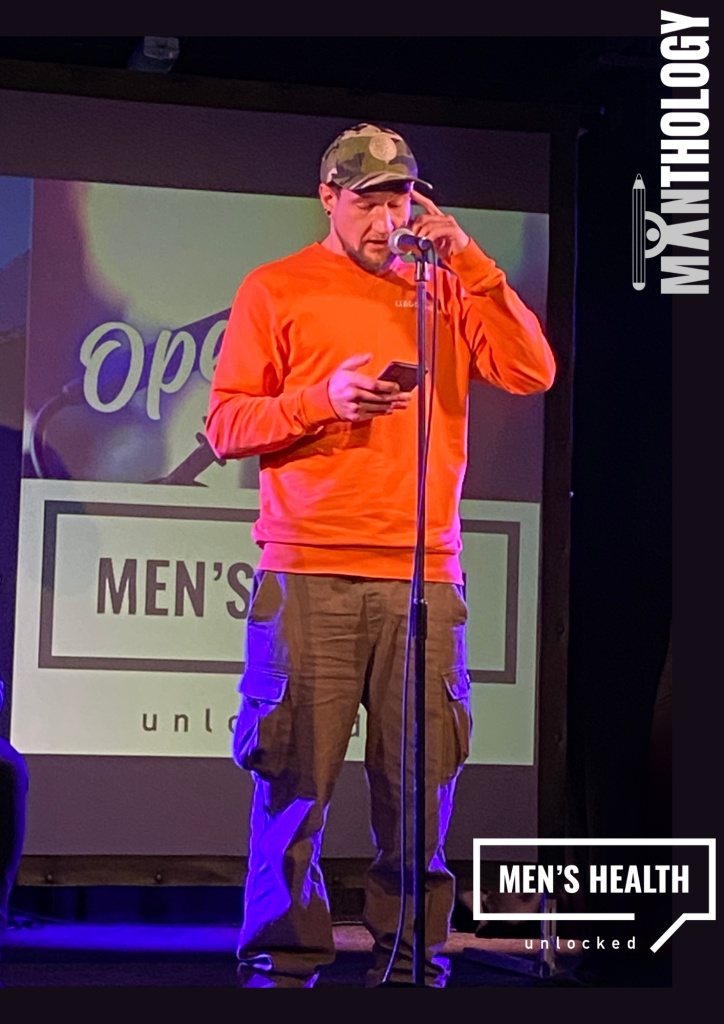
Warren Smart, Manthology Launch. Photo Credit: Maz Sultan.
After the panel event, the rest of the day was given over to poetry – more than 20 men took to the stage and laid themselves open, some in a way they never had before. For me, being on stage is familiar, but I was much more nervous than usual for this short set – most of the poems were different from what I usually do, and I felt very vulnerable. I was so nervous that I forgot the first lines of my first poem, and found myself staring at the crowd in silence. Luckily they were supportive and patient, and I had the time to get started properly and then I was away. Poets went up in batches and next to me in my cohort was a young man called Warren Smart, who had a back-story of trauma and addiction, and who was reading in public for the first time. His words were sincere, heartfelt and authentic, and he read them as if he was a seasoned performer. I hope he inspired many more men in the audience to give it a go too.
Every year when it is International Women’s Day, there are smart-arses who demand to know when International Men’s Day is. There are two answers to this – one is “every other bloody day of the year”, and the other is 19 November. On that day, 2 days after the Manthology event, I met some of the people I had appeared with again, this time at Kirkgate Market, where various men’s mental health stalls were set up, and we were even able to get a free haircut!
Over the following ten days, I would be at other events, not specifically on this theme, but which nevertheless had me thinking about it again. The following Sunday, I was at Chapel FM to see the celebrated Palestinian poet Mohammed Moussa, with magnificent support from Abdullah Adekola and Sarah Smout – his visit was impressively brokered by Say Owt’s Henry Raby. The Friday after that, thanks to Scarborough-based poet Nell Williams, I was one of the supporting poets for his Scarborough gig, and drove him there from Leeds. I couldn’t help thinking that the issue of men’s mental health might seem a trifling luxury to people from Gaza, yet it was clear that his poetry, and his performance of it, was shot through with personal struggles as a traumatised man.
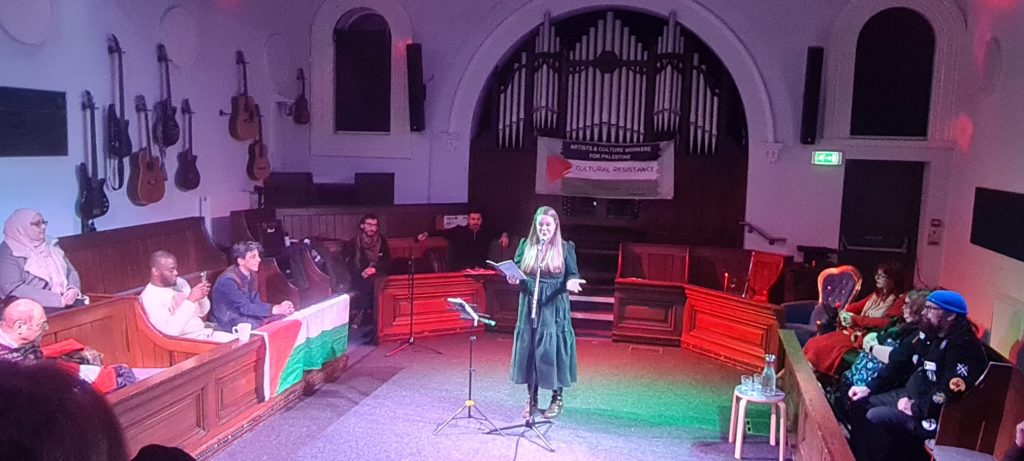
Sarah Smout at Mohammed Moussa gig, Chapel FM. Photo Credit: Keith Fenton.
In between those two gigs, I went over to Verbose in Salford. Before I read, a young woman called Megs Hegdekar did an extraordinarily powerful poem about domestic abuse she had suffered. Of course, anyone who read my first column in June will know that domestic abuse sufferers and survivors have been getting together on our Leeds scene, so I made a point of speaking to her afterwards, along with a couple of the hosts, Becky May and John Clifford. What I did not expect was for this conversation to lean into men’s mental health, but I learned that Megs engages with the problem of violence against women from a number of angles, including that one. She has also found poetry to be a powerful tool in her fight against trauma.
These things all join up in the end, I’m glad to say. The creative circuit works best when it produces communities of people at all levels of skill and experience, rather than concentrates only on elites. I tend to think the word “elite” works better as an adjective rather than as a noun. We do of course have elite performers – that is a good thing and gives us all something to aspire to – but elites themselves exclude others and break the pipelines of talent into our scenes. Bringing the usually newer “cathartic” poets (again, see my June column) into the same spaces as the accomplished performers energises all of us and helps to ensure that the voices of people working through pain are given a fair platform for their creativity. And specifically when they are men, in an era when vulnerable men are being encouraged to be increasingly toxic, this is a crucial pressure valve for them and everyone around them.
***
Filed under: Poetry, Written & Spoken Word
Tagged with: International men's day, Keith Fenton, leeds poetry, Mens mental health, mental health, poetry, poetry event, spoken word, vulnerability, Writing the North

Comments