
West Yorkshire Writes: From Manningham to the Women’s Prize with Marcia Hutchinson – Interview
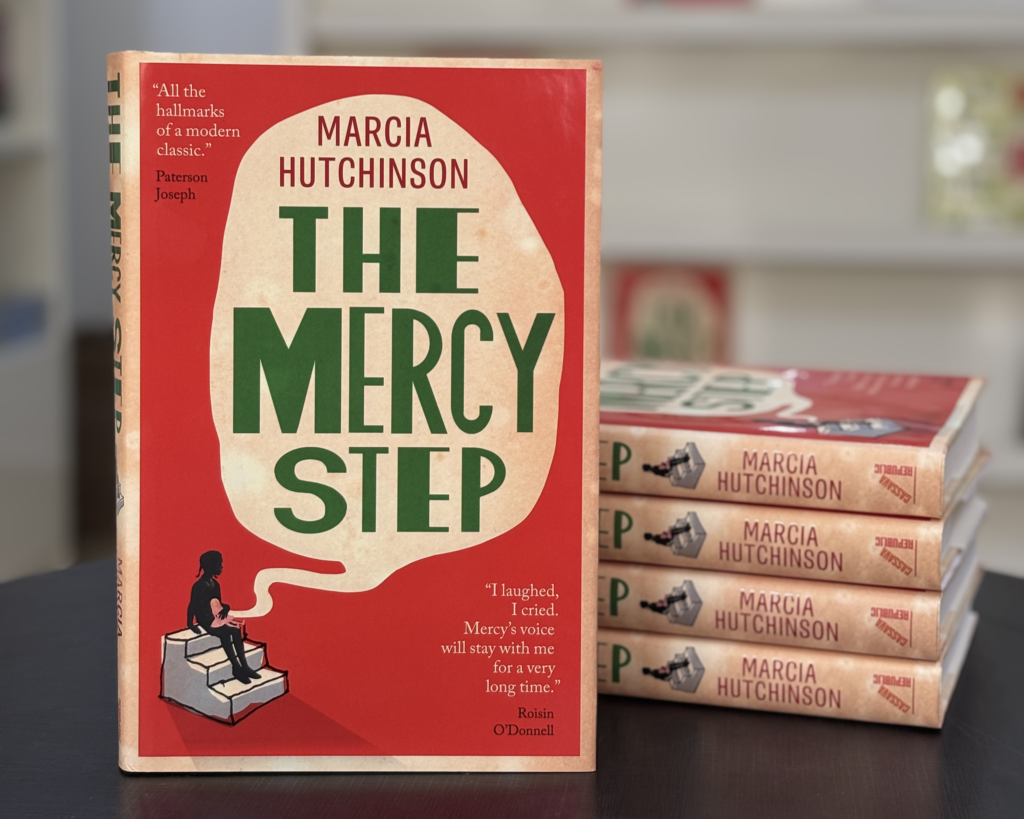
‘The Mercy Step’ book cover. Image Credit: Cassava Republic Press.
Marcia Hutchinson has forged a varied career, working as a solicitor before moving into education and children’s publishing. Now 63, Marcia is an award-winning writer whose debut novel, ‘The Mercy Step’, was published by Cassava Republic in July 2025. Drawing on her early life in Bradford, The Observer named it one of 2025’s best new novels. It went on to win the Discover Award 2026 and was shortlisted for this year’s Women’s Prize for Fiction, alongside her fellow West Yorkshire writer, Rozie Kelly.
‘The Mercy Step’ follows a feisty, ambitious and witty young girl called Mercy, broadly based on a younger version of Marcia, from before birth to the age of eleven. Marcia describes the novel as autofiction, combining memory with imagination. When writing the first draft, she would write what she could remember, and when she ran out of memories, she’d imagine what she might remember if she could.
“For instance, when the novel opens, clearly, I don’t remember being inside the womb. But how might a character like Mercy feel about it? Without consciously thinking, I knew she’d be very annoyed about the cramped conditions,” Marcia laughs.
Marcia doesn’t know where Mercy came from. “It’s as if the character of Mercy was already fully formed, and all I had to do was ask her and she’d tell me the answers.” Explaining her writing process, this turns out to be almost literally true. Rather than sitting down to write, Marica took her dog for a walk and dictated the story into her phone. “I just opened Google Docs and dictated straight into that, almost as if I was having a conversation with little Mercy. Walking along, holding her hand and saying to her, ‘You tell me, and I’ll tell them.’”
She describes it as a “weird liminal space” where she was simultaneously herself and the character. “I knew it was coming from me, but it was also coming from so far away. It was as if I had to try and bypass my consciousness and get to Mercy. Quite often, in these conversations with Mercy and the dog, I’d end up sat on a park bench crying. Equally, I’d sit there laughing when the funny stuff came up.”
The result is a novel that captures a child’s perspective so convincingly that the doom and gloom of the adult world gives way to the innocence, creativity, imagination and humour of a child’s mind.
Much of the novel is founded on the relationship between Mercy and her mother, which Marcia suggests goes right back to her own infancy. “I didn’t see my mum for nearly nine months of my first year because I was in hospital with pneumonia. She told me that when I did finally come out of hospital, I would only go to white people. I wouldn’t go to her. So, she made a point of never putting me down. Always holding me. I think that had a counterproductive effect – if she did put me down, I would scream the house down.”
Marcia explains that, ordinarily, children go through a natural process of growing up where they learn to disengage from their parents. “We learn where they stop and we start, but that developmental process has been disrupted between Mercy and Mummy.”
For Marcia, their relationship is one of the most moving parts of the book. “As you get closer to the end, you see Mercy start to realise that she is a different person from her mother, that she cannot realise herself and her ambitions until she separates from her. She and her mother disagree on fundamental aspects of life: religion, Christianity, periods. They’re going to have to live with those disagreements because they’re not one and the same person.”
It’s a poignant reflection of learning to grow up, carrying the parts of your parents with you that you admire, while moulding the other parts with which you disagree. Mercy carries a pride in her heritage and ancestry – something Mummy fostered – but also has a love of books and learning which her mother doesn’t necessarily value.
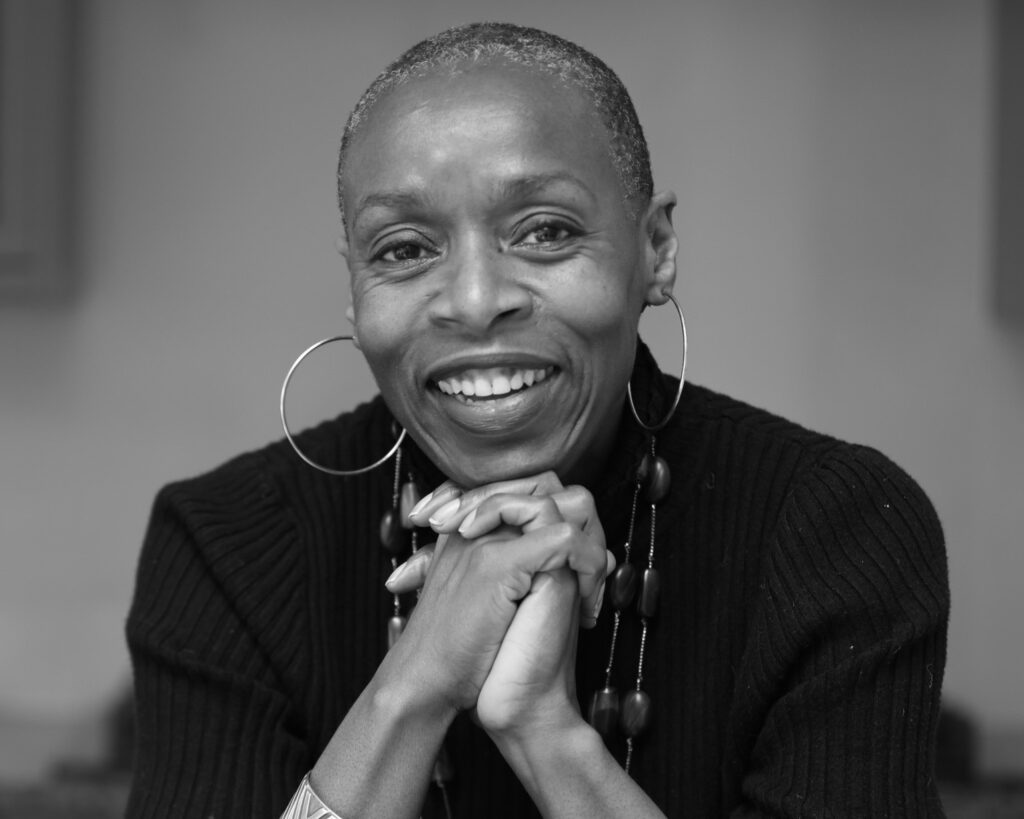
Marcia Hutchinso,. Photo Credit: Simon Brock.
As well as family, the novel explores Bradford itself: its streets, neighbourhoods, schools, libraries and people. Marcia says that she didn’t consciously set out to write Bradford into the novel. “I knew that Bradford was almost going to be a character in itself, but if I tried to consciously write the stone walls, the Lowry, the Hockney, or the Priestley it just wasn’t going to sound authentic. So, I just wrote whatever I remembered from growing up in Manningham.”
For Marcia, telling a Northern story and representing the experiences of post-war Jamaican migrant families in places like Bradford was important. “I think there is an automatic assumption that an English experience is based in London.” She points to Lanre Bakare’s ‘We Were There’, which also explores the experiences of Black people in Bradford. “Between him and I, we are expanding the experience of living in the North, particularly Bradford, for the Black community. When you talk about Bradford, people think of the Asian community, so we’re almost the minority minority. Few people know we were here, are still here.”
‘The Mercy Step’ is not the first piece of work Marcia has done to champion overlooked stories and histories. In 1997, she set up Primary Colours, a multicultural educational publishing and training company that created educational resources. “At the time, there were more teddy bears as lead characters in children’s books, than there were black children. Sadly, 30 years on and things are still quite similar,” Marcia says.
Nevertheless, ‘The Mercy Step’ shows Marcia’s continued commitment to decolonising the curriculum, despite the slow progress. One of the resources created by Primary Colours was ‘The Journey’, which included an interview with Marcia’s mother about coming to England. “It hadn’t occurred to me that it would form part of a novel I’d write 30 years later.”
‘The Mercy Step’ has already attracted interest from schools, though, to Marcia’s surprise, not for its Caribbean aspects, but for its exploration of child abuse. Marcia says headteachers have spoken to her about children in their schools experiencing what happened to Mercy, and see the book as a way of addressing difficult subjects appropriately with 11- to 14-year-olds.
Mercy’s love of the library is one of those subtle ways the novel explores trauma. Growing up in Manningham and attending St Paul’s, Marcia would go to Manningham Library every evening after school and stay until closing. “The librarian would tap me on the shoulder from behind and tell me it’s closing time, internally I was thinking, ‘No! I don’t want to leave.’”
She compares the library to the children’s television show ‘Mr Benn’, where the character enters a shop, dresses up and steps into another world.
“That was the library for me. When a child can’t physically get away from a difficult situation, they can get away in their imagination, and no one can take that away from them. For Mercy, if she can get the knowledge into her head, nobody can get it back out again, and so she lives in a book.”
‘The Mercy Step’ book cover. Image Credit: Cassava Republic Press.
But Marcia also highlights the darker undertones of this escapism. Mercy’s retreat into books becomes a form of dissociation, taken “a lot further than the average child who gets lost in a book”.
“She doesn’t know she’s got PTSD and is dissociating, and I didn’t want to lose any of the magic by including those psychological terms, but I wanted the reader to be able to pick up on it. The machete incident is splitting bits of her off, and she’s not the same person she would have been if it hadn’t happened.”
In this way, Mercy’s childhood becomes intertwined with Marcia’s adult journey of coming to terms with her past.
“A big chunk of why I wrote the novel was because in my mid-’50s doctors diagnosed me with PTSD and I wanted to know what caused it.”
Not all of it was easy. At times, Marcia found the process so difficult that she had to stop and write other things. She describes writing the machete chapter as “like scraping out my insides with a blunt rusty spoon”.
“But I knew it was good for me,” she continues. “I knew I needed to do this. I knew I needed to get it out, but what I didn’t know in the process is that I could write literature.”
Only when she started attending creative writing groups, reading her work aloud and receiving feedback did she begin to believe it was good. From there, the tumultuous journey to the Women’s Prize began.
“The response has been phenomenal!” Marcia exclaims. “It’s my wildest dream. Actually, it isn’t – that would have been to be longlisted for a minor literary prize. I’d have been happy to be longlisted for the Manningham literary prize. But, shit, it’s the Women’s Prize!”
At the Women’s Prize event, Marcia says she had people coming up to her every five minutes to tell her how much they loved the novel – and not just Black women. “There are lots of women who identify with Mercy.” For Marcia, this feels especially poignant considering how long it has taken her to get here. “I’m 63 now. Nobody writes their debut novel at 63. I wish I could say to Mercy… ‘See? We did it. It took half a century, but we got there and the world has recognised your genius.’”
After decades spent championing other people’s stories, Marcia has finally had the chance to tell her own – and, in Mercy, has created a character whose story has reached far beyond Bradford.
***
‘The Mercy Step’ is available to buy online and in bookshops.
Marcia is currently on tour with ‘The Mercy Step’ and Rozie Kelly at venues across the country, including Waterstones Bradford on Wednesday 7 October; and Ilkley Literature Festival on Sunday 18 October.
You can keep up to date with all her latest news, events and book releases on her website and Instagram.



Comments