West Yorkshire Writes: Rozie Kelly on Her Women’s Prize-Shortlisted Debut ‘Kingfisher’ – Interview
June 6, 2026
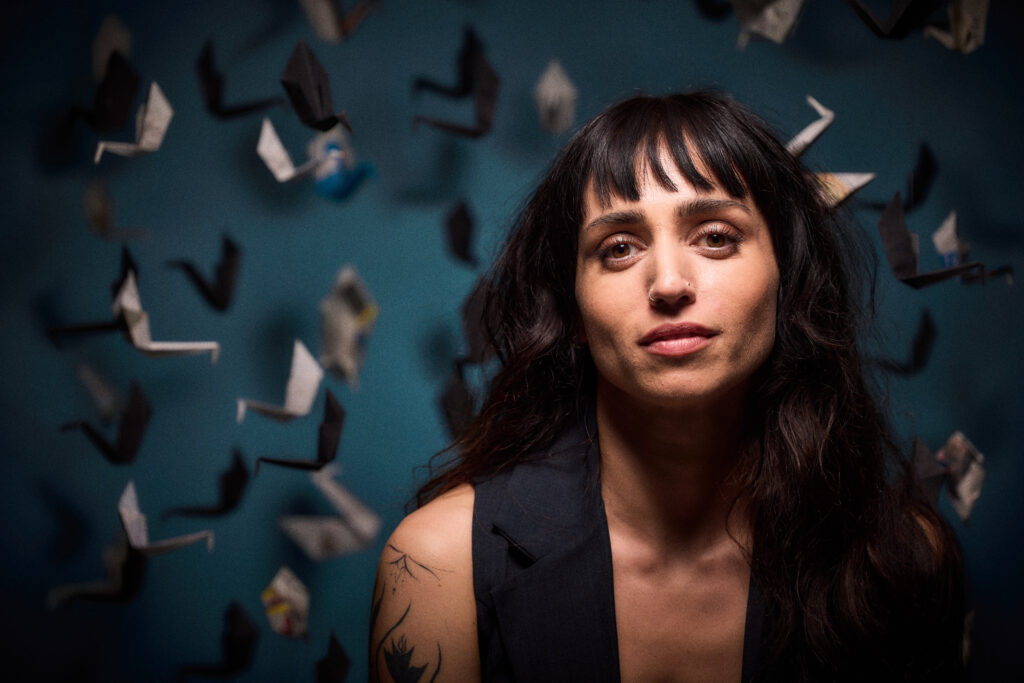
Rozie Kelly. Image Credit: Harvey Williams Fairley.
Rozie Kelly is a novelist based in Hebden Bridge, where she works for the Arvon Foundation hosting creative writing courses. Her debut novel, ‘Kingfisher’, published by Sarabrand in 2025, won the 2024 NorthBound Book Award and was recently shortlisted for the Women’s Prize for Fiction 2026. We spoke to Rozie about her powerful debut, which explores grief, desire, power, identity and the complicated ways people seek love, as well as the consequences when they fall short.
Rozie’s journey to writing her first novel began long before literary awards entered the picture. “I’ve always been really interested in stories,” she says. “I was a real daydreamer as a kid, constantly making worlds with all my toys. My mum tells me I would write her little poems, which she kept in her purse.”
A difficult period during her teens led her away from creativity, but she returned to education at twenty-seven, completing an undergraduate degree in English Literature and Creative Writing that reignited her passion. “My English Lit and Creative Writing degree reminded me how important writing and reading were. I went straight on to do a Creative Writing master’s after that. I graduated from my MA in 2020 and I’ve been writing pretty consistently ever since.”
Her first novel is a deeply introspective narrative following the thoughts and feelings of an unnamed creative writing academic who becomes infatuated with his older colleague, known only to the reader as the Poet. Rozie explains that she came to write this novel because the protagonist’s voice just came to her. “The first page of the book just sort of came out of nowhere and has changed very little since the first day I wrote it,” she says. After that first chapter she was intrigued by his voice and knew she needed to keep writing him. “His voice was so fully formed and complete in my head that all I really had to do to get to know him was put him in situations to see how he would react.”
As the narrator developed, so too did the women who surrounded him. “As I followed his voice, he became a lens through which I got to meet all these really interesting, complicated and flawed women. In the end, I ended up being more interested in them, as much as I feel very connected to him as a character.”
One of those women is the Poet, who exerts a powerful influence over the narrator. Rozie was fascinated by their dynamic because it reverses one so common in both fiction and everyday life. “We often see young, beautiful, perhaps a bit naïve women in relationships with older men defined by their success, status and money. I just thought, ‘How boring?'” Instead, she became interested in where power actually resides. “Does it come from status, or from gender?” she wonders. “I thought I’d experiment by flipping the dynamic around.”
Questions of power therefore sit at the heart of the narrator’s relationship with the Poet. Rozie explains that the kind of control she wanted to explore is not uniquely male, but often emerges from feelings of fear or insecurity exhibited by men. “My interpretation of the protagonist is that he feels quite disposable in his relationship with the Poet. And not without legitimacy – there are many ways in which she is using him. He has a huge amount of emotion for this woman who doesn’t necessarily feel it in return and therefore, in their relationship, he tries to get a grasp on that in different ways so he doesn’t feel like he’s drowning.”
The Poet herself remains elusive throughout the novel. She is never named, creating a distance between both narrator and reader. While the anonymity of the protagonist emerged accidentally, Kelly says “there was no point where I was ever going to name the Poet.”
The decision reinforces the fact that readers only ever encounter her through the narrator’s perspective. “I wanted it to be really clear to the reader that everything we’re getting is through his lens, except for this one scene where she’s being interviewed and, for a split second, it slips into her voice.” That moment is crucial because it reveals a subtle but important discrepancy. “Her voice doesn’t talk quite like he’s been making her sound. I think it represents that even though we’re in his head and getting his quite raw and honest thoughts, he’s also very unreliable.”
For Rozie, this idea of partial understanding lies at the heart of the novel’s title. Like the bird itself, the Poet remains impossible to fully grasp. “Kingfishers live these solitary, mysterious lives and if you get to see one, you just catch this little flash out of the corner of your eye.” Like a kingfisher disappearing through the trees, the Poet is vivid, magnetic and tantalisingly out of reach, only ever glimpsed in flashes.
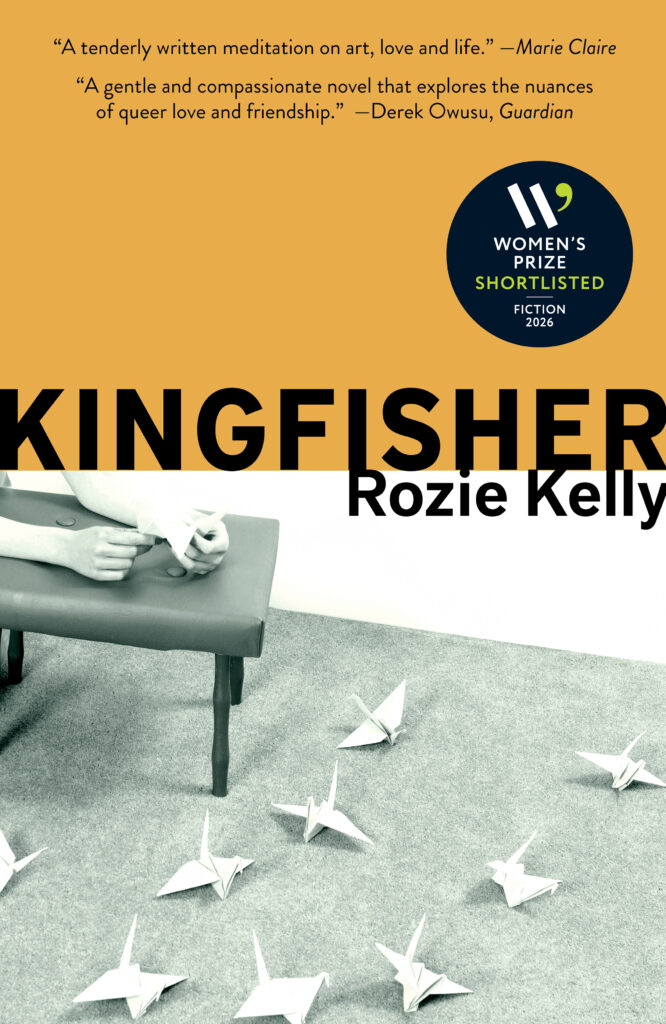
Kingfisher shortlist cover. Image Credit: Sarabrand.
Another important woman in the novel is the protagonist’s mother, Hetty: a deeply controlling, homophobic and critical presence in his life. Rozie describes her as “the villain of the novel, if there is one.” Laughing, she admits this is familiar territory. “I have this habit of writing really nasty mums. I do it all the time and feel really guilty because my mum is so lovely – she’s an angel. But I am endlessly interested in switching stereotypes.”
For Rozie, the damage Hetty causes stems from the expectations attached to motherhood itself. “Broadly speaking, your mum is supposed to be a place of security, safety and your first understanding of home and love. Even before you’re out of the womb, you’re being nourished by this person. So when that person fails so spectacularly to do the thing they are supposed to do there’s no way that isn’t going to have a huge ripple effect through the rest of your life.”
Ultimately, Rozie sees Hetty as the root of many of the narrator’s struggles. “She’s why the protagonist is the way he is. He’s trying to find the love he didn’t get, or find someone who can teach him how to love.”
Despite searching for that love in the Poet, the person who comes closest to providing it is his best friend Jessica, who Rozie describes as someone “essentially willing to sacrifice herself almost entirely” for those she cares about.
Jessica emerged from Kelly’s desire to create someone capable of cutting through the protagonist’s “nonsense”. Drawing on friendships from her own life, Kelly imagined the pair sharing a relationship built on “those catty, silly, sort of pseudo-flirting things that I think sometimes straight women and gay men play around with. As soon as I introduced that into the scenes, I immediately loved her.” She laughs before adding: “In fact, I think she’s the only decent person in the whole thing.”
Yet Jessica’s goodness is more complicated than it first appears. While she genuinely cares for the people around her, her relationships are not entirely free from questions of power and control. “In her relationship with the protagonist, she knows that if she mothers him, he will behave in a certain way. Therefore, he fulfils this role which she needs because she has a miserable love life and fundamentally doesn’t value herself as highly as she probably should.”
In many ways, Jessica acts as a foil to Hetty. While Hetty represents a failure of the nurturing role traditionally associated with motherhood, Jessica fulfils that role almost to her own detriment. “The whole time I was writing her,” Rozie says, “I kept thinking, ‘Oh, for God’s sake, just tell him to pull his own pants up and go live your own life.'”
The last few months have been a whirlwind for Rozie. Following the publication of ‘Kingfisher’, she found herself first on the Women’s Prize for Fiction 2026 longlist and then among the six shortlisted authors. As a debut novelist, she is still adjusting to the attention. “I struggle to believe it’s all happening,” she says, “but it definitely is because I went to a celebration party with real people.”
The nomination has also felt particularly special because of the team behind the book. “For my publisher – or certainly everyone I’ve worked with – it’s an all-female team, so it feels like we’re all celebrating together. The whole thing has just been such an honour.”
Whatever happens when the winner is announced, ‘Kingfisher’ has already marked Rozie out as a distinctive new literary voice. Like the bird that gives the novel its title, the book is elusive, intimate and impossible to pin down completely. Through its exploration of desire, grief and the stories we tell ourselves about love, ‘Kingfisher’ asks whether we can ever truly know another person and lingers in the mind long after its final pages.
***
‘Kingfisher’ is available to buy from Sarabrand and booksellers nationwide. The winner of the Women’s Prize for Fiction 2026 will be announced on Thursday 11th June from 6.30pm and you can follow along live.
To keep up to date with all the latest information from Rozie Kelly you can follow her Instagram.


Comments