
West Yorkshire Writes: Suhaiymah Manzoor-Khan on putting Muslim stories centre stage – Interview
October 20, 2026
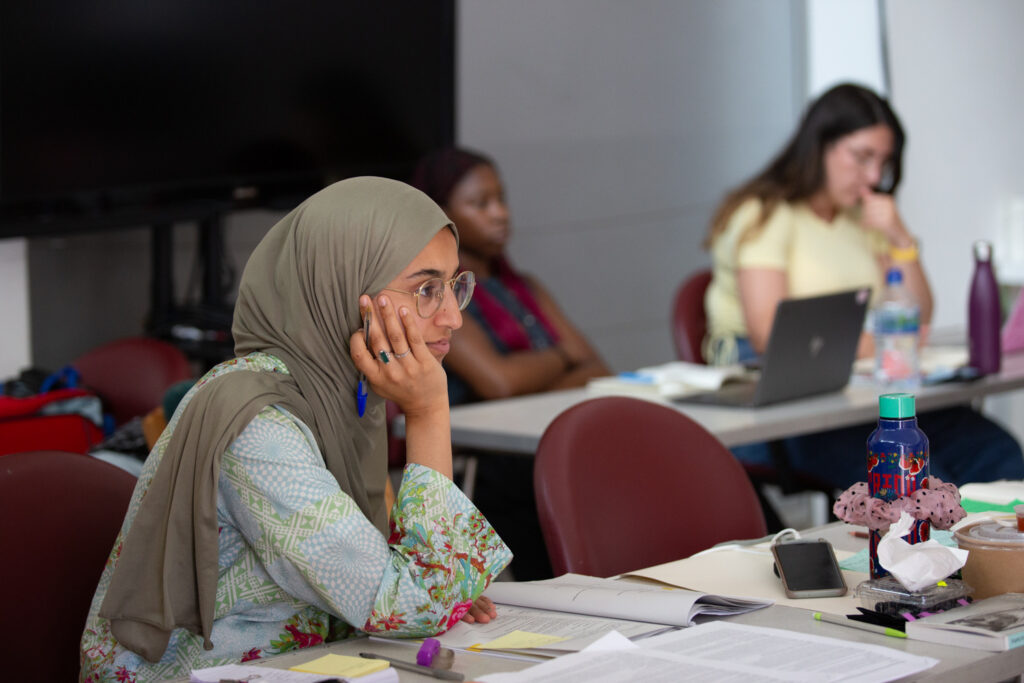
Writer Suhaiymah Manzoor-Khan in rehearsals for the original Kiln Theatre production of Peanut Butter & Blueberries. Photo Credit: Oluwatosin Daniju.
Suhaiymah Manzoor-Khan is an educator, writer and poet originating from Leeds whose work explores race, power and faith, challenging dominant narratives around Muslims, migration, gender and violence. Having published three non-fiction titles and gained international recognition for her poem ‘This Is Not a Humanising Poem’, she now brings ‘Peanut Butter & Blueberries’, her first full-length play, to Leeds Playhouse.
First produced at Kiln Theatre in August 2024, its arrival in Leeds feels like a homecoming. From the beginning, Suhaiymah wanted the production to reach northern audiences, “not just for me, but because the characters are northern.” Hafsah is from Bradford, while Bilal is from Birmingham. Although London audiences still connected with the story, Suhaiymah and director Sameena Hussain hope that the characters share the region’s cultural reference points and sense of identity.
Bringing the play to Leeds also means that friends and family who couldn’t travel to London due to cost and accessibility will finally have the chance to see it. “It feels really important they’ll all get to be there. However, I also think I’m more nervous because of that – the stakes feel higher,” Suhaiymah laughs.
At its heart, ‘Peanut Butter & Blueberries’ is “quite straightforward… It’s essentially a love story,” Suhaiymah says. Hafsah, a postgraduate student, meets Bilal, a more rough-and-ready undergraduate, at university. While Hafsah isn’t looking for love, she finds herself catching feelings for Bilal.
Suhaiymah says she “loves a good love story” and wanted to explore romance through the experiences of two practising Muslims. “There are dating apps for Muslims, I guess with the caveat that most Muslims are gonna be looking to get married,” she says. “At university relationships were a big topic of conversation between me and my friends, we always hoped to romantically bump into someone in the library or whatever,” she laughs.
Similarly, for Hafsah and Bilal, faith shapes their relationship. As Suhaiymah explains, “the story isn’t necessarily going to reflect the culture of relationships that we see in the wider sphere.”
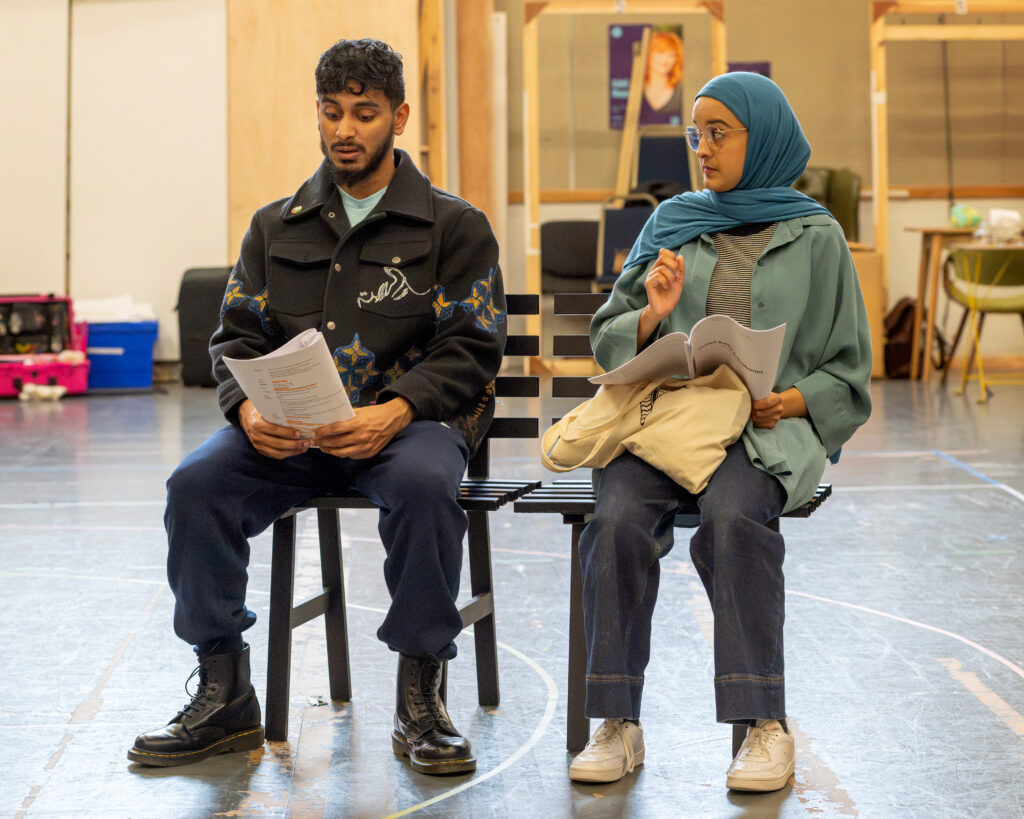
Kashif Ghole (Bilal) and Humera Syed (Hafsah) in rehearsals for Peanut Butter & Blueberries. Photo Credit: Robling Pix.
That distinctiveness was what first inspired the play. Suhaiymah was asked if there was a story she’d like to see which wasn’t being told? Her response: “I want to see Muslim characters who like being Muslim.” What she means by that is “for many people faith is the source of hope and resilience, the thing that helps them to move through life, make sense of complications, dynamics, relationships etc.” Yet these experiences are rarely represented at all on stage. As a result, Suhaiymah’s characters are happily Muslim, reflecting a lot of people she knows. “Islam is not the obstacle in the play,” she says, “it’s not about overcoming their culture, or their family, instead, it’s about what it means to be a young Muslim today.”
Suhaiymah’s previous non-fiction work explored those challenges in detail, analysing Islamophobia and the ways racism operates across society. “During the COVID and post-COVID era, I was really thinking about what racism is and how it operates on a national level, an international level, at the border, thinking about themes of migration, gender, surveillance etc.,” she explains.
While ‘Peanut Butter & Blueberries’ builds on that overtly political writing, Suhaiymah wanted to weave these wider realities into the story without making it feel too on the nose. She explains that, “the heavier topics in this play reflect the reality that we are young people, having a laugh, surrounded by the same reference points, but there are subtle ways in which decisions are made for us.”
Suhaiymah highlights that 50% of Muslims in the UK live below the poverty line, explaining how this affects Bilal’s relationship with Hafsah: “For Bilal, that fact shapes the decisions he makes because he questions whether he can give Hafsah the life he thinks she deserves.”
Surveillance is another pressure facing the characters. Suhaiymah underlines research by student unions suggesting that counter-extremism policies, including the Prevent duty, can make Muslim students more cautious about participating in certain discussions. They become “less likely to answer questions they fear might make them look strange or suspicious.”
Bringing these themes to the stage challenged Suhaiymah to consider the relationship between dialogue and stagecraft. “There’s a big letting go process which I’ve not had with my books and poetry. I realised just how much of the story is brought to life by the decisions and stagecraft of other people.” Therefore, she thought carefully about what needed to be said and what could instead be conveyed through a look, movement or set design. “I’m not a very visual person, so the whole process of seeing it come to life was amazing and made me realise how much more rewarding and exciting group projects are because you can build the final thing together.”
Rehearsals were the most exciting part of the process, Suhaiymah says, as the actors brought so much of themselves to their characters. At first, they would ask her why a character made a particular choice. Gradually, she began to hand the characters over to the actors, until they were the ones questioning her decisions. “‘The actors were saying, ‘I actually don’t think she would do that. Can we try it if she does it like this?’ I loved that because it was just like, ‘Wow, that’s your character now, and you’ve done that much better than I wrote.”’
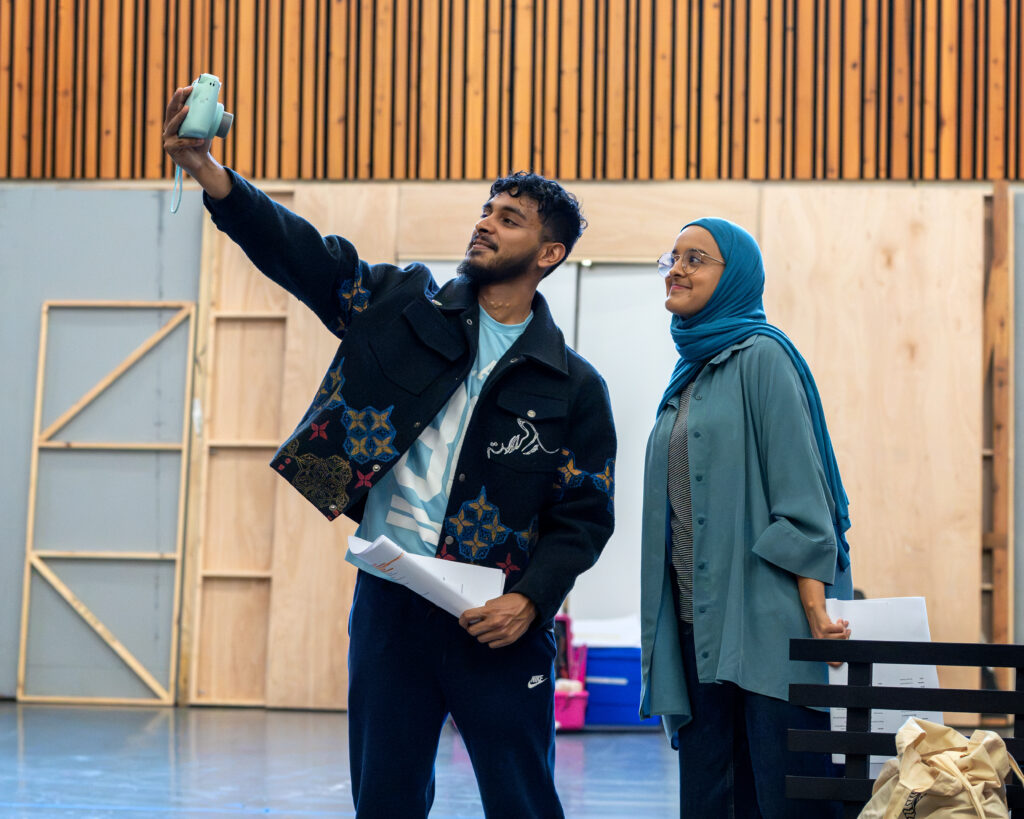
Kashif Ghole (Bilal) and Humera Syed (Hafsah) in rehearsals for Peanut Butter & Blueberries. Photo Credit: Robling Pix.
Alongside the cast and creative team, Suhaiymah worked closely with Sameena Hussain, the production’s director. The pair had collaborated before: in 2022, Suhaiymah took part in Leeds Playhouse’s Writer-in-Residence scheme when Sameena was Associate Director. Since then, Sameena has supported Suhaiymah’s work. “She champions marginalised voices and people whose identities are not at the forefront of theatre. One of the things that she wanted to do with her role at the Playhouse was show that theatre isn’t just for white middle-class audiences, which perhaps we perceive it to be sometimes.”
Suhaiymah was equally keen for Sameena to direct the play, “I knew I wouldn’t have to explain or defend what it means for these characters to be Muslim or to have Pakistani heritage in the north.” As Suhaiymah puts it, this production “feels like a really nice pinnacle to a long, supportive relationship.”
Another priority for Suhaiymah was ensuring that the people whose stories are told on stage would feel comfortable and welcome in the theatre itself. “If I wrote a play trying to honour the Hafsahs and Bilals of the world, but the real people who live lives like this can’t come and see it, that feels futile.”
Drawing on her own experience, Suhaiymah explains, “If I go to a play, one of the first things I’ll think about is when the prayer times are, and whether I’ll be able to watch the play and still pray at those times.” She also encouraged the Playhouse team to think more broadly about accessibility, from ticket affordability and travel costs to who audiences might attend with, and how to make the building feel welcoming and familiar from the moment they arrive. In response, the production is offering prayer spaces, a multi-faith reflection space and a dedicated alcohol-free bar.
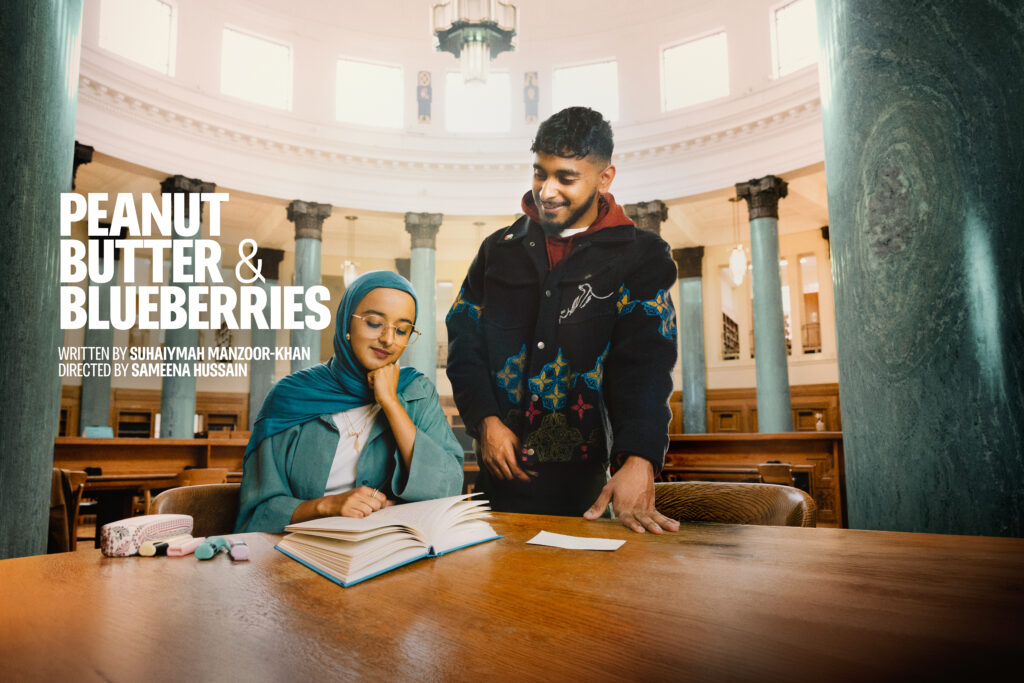
PB&B Artwork. Image Credit: Leeds Playhouse.
At the Kiln Theatre the impact of these changes was striking. Staff told Suhaiymah they had never welcomed so many Muslim audience members; “on some nights, the prayer room was overflowing,” Suhaiymah says, and entire rows of women wore hijabs — something which is “quite unheard of”, even in London. Suhaiymah explains that within theatre, there is often an idea of “hard-to-reach” audiences, but these few decisions show “it’s not that the audience is hard to reach, people are hungry to come, it’s that we just aren’t putting on things in the right way.”
Making space for underrepresented experiences is at the core of Suhaiymah’s work. “I’m just hoping to show somebody something they haven’t thought about before, open their eyes, or make them ask questions.” With ‘Peanut Butter & Blueberries’, she particularly hopes to empower practising Muslims to feel they don’t need to be apologetic about their experiences. “We can navigate and experience things in our own way, write and talk about it without having to mask or hide it just to try and fit in.”
For audiences less familiar with Muslim experiences, she hopes the play will offer a different kind of recognition. “Hopefully, people will think, ‘I’ve experienced that too,’” Suhaiymah explains, “because fundamentally the play is about human emotions we all feel.” For her, that recognition is a starting point for something bigger: “If enough people have that shift internally, then I think that will have to manifest externally.”
***
‘Peanut Butter & Blueberries’, written by Suhaiymah Manzoor-Khan and directed by Sameena Hussain, runs at Leeds Playhouse from 22 Oct – 7 Nov 2026. Book tickets here.
Follow Suhaiymah on her website and Instagram. For further reading on Islamophobia, racism and Britishness, Suhaiymah recommends: Arun Kundnai’s, The Muslims are Coming, Rizwaan Sabir’s, The Suspect, Tarek Younis’, Muslim, Mind and State and her own book Tangled in Terror.
Filed under: Theatre & Dance, Writing
Tagged with: accessibility, debut, inclusive, leeds playhouse, muslim, Northern identity, Peanut Butter & Blueberries, Suhaiymah Manzoor-Khan, theatre


Comments