
Kimberly Campanello at More Song. Image Credit: Tom Branfoot.
Each month Keith Fenton, a Leeds-based performance poet, broadcaster and host of Poets Talking Bollocks podcast, explores the events, people and debates shaping literary culture in the North. This month, he turns his attention to the old debate about the difference between page poetry and stage poetry, arguing that the divide might not be that great.
I hope you can excuse my column being a little on the late side. Fate took out the first part of May, not quite up to the Ides, but way past the Nones, as I went from Holmfirth (where I read at my friend Ebi’s beautiful literary event in the Civic Hall) to Ty Newydd near Criccieth in North Wales for the best part of a week on a residential with the wonderful poets Vicky Morris and Ness Lampert and back to Leeds to prepare for my own monthly poetry event Poets Talking Bollocks Presents at The Chemic on Sunday 10 May, featuring magnificent showcase sets from Vanessa Napolitano, Theo Dyrøy and Masego.
At Ty Newydd, the old debate about the difference between page poetry and stage poetry came up late one night. I struggled to get my point across at the time – I put it down to tiredness – so an idea for the next column began to emerge. I think there are people eminently more qualified to tackle this issue, but as someone who walks a tightrope between page and stage, I reckoned a short discussion piece wasn’t beyond me.
When I belatedly began to develop my craft a few years ago, I immersed myself in page-poetry and I would read it out on East Leeds FM (now East Leeds Community Radio)’s Deli show. Although that was a type of performance, the medium tended to make it feel like reading off the page. The Covid lockdowns happened soon after I started this, and that is when the immersion began. I went on courses, learning first how to read, then how to craft, poems on the page. Online readings would be by page poets, and where there was also an open mic, I would send my readings – off the page – over the Zoom link.
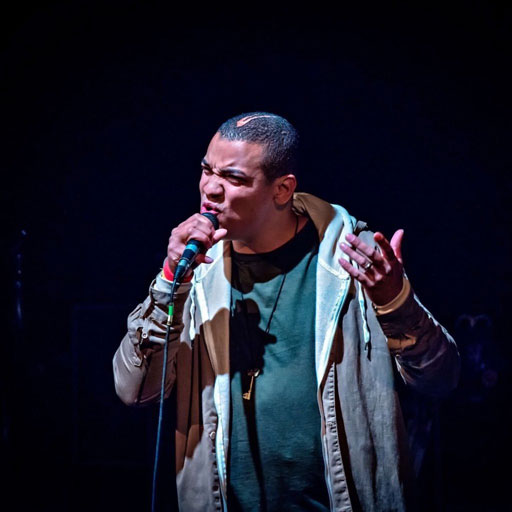
Testament. Image via: https://firststory.org.uk/.
Gradually, things opened up again, and I began going to as many live readings and open mics as I could. I considered what I was doing “reading” rather than “performing” and I didn’t really take notice of any page-stage debate, at that stage I couldn’t really see any dichotomy. Some confirmation of this came the first time I asked poet Joe Williams – attendee at, and host of, a number of Leeds poetry events and author of several pamphlets/collections – about this issue. His response was: “the better your poem is on the page, the better your performance is likely to be.”
I still broadly agree with this rule of thumb, but since then I have “written” a piece that I simply don’t think is a page-piece. I composed it in my head in 2023 in the months leading up to the unveiling of the Hibiscus Rising statue for David Oluwale. I did “write it down” but with little regard for poetic structure, and I have never performed it other than from memory. I first performed it at Matt Abbott’s much-missed Tubthumping in November 2023, and have performed it often since. Culture Matters has it alongside another of my Oluwale poems on their website, along with a commentary – it isn’t formatted how I’d like, but in all fairness I don’t know how to write it correctly anyway. Essentially, it follows the structure of a song – the 9 stanzas are divided by a refrain, which is repeated (and then subverted) towards the end. On stage it feels powerful, and audiences – even ones not used to poetry – tend to pay attention.
And yet. At the time I “wrote” it, I was also writing more stage pieces, ones which were inspired by the verbal dexterity and virtuoso rhyming-schemes I was hearing on the circuit. While I don’t do slam poetry, I find the skills of many slammers to be astonishing, and I definitely use some of their techniques to build rhythm and control pace. I had just embarked on a Creative Writing MA at Leeds Trinity, and many of the poems I brought to workshops were pieces I had developed through performance. Many others weren’t, and I was increasingly starting to see a distinction between the two as I became technically more aware. One of my biggest weaknesses was line-breaks, and I worked especially hard to improve my mastery of them. I suspect the lack of control was informed by the fact that on stage they would often vary. In performance you will often change the rhythm to fit a space, an audience, an occasion, or simply to impart subtly different meanings, and so I had sometimes come to see the written poem as a mere guide.

Maria Ferguson. Image Credit: Suzi Corker.
These poems – whether page or stage ones – have become stronger in both arenas. The exception is ‘Who Killed Oluwale?’ Read on the page, it has many, many technical deficiencies, and is a poem I would not write now because I would try not to write deficiently. But it remains a powerful piece which has brought an important name and set of social-justice issues to people, and I would rather it continue to do that than sit nicely on a page. (This is similar to how my friend Sarah Rooke views her poetry about domestic abuse – see my first column nearly a year ago.) And I consider myself lucky to have written it when I did, or it might not have happened!
The poetry world is packed with snobbery. In many ways, this is a good thing – we should insist on high technical standards in our craft – but in my view it can also be reductive and exclusionary. Poets are a diverse bunch, who use huge skill to communicate, but the skills they use vary, and are all valid. On the Poets Talking Bollocks podcast, we broached this topic with one of this country’s top poets and educators Andrew McMillan. One of the great performance poets, Benjamin Zephaniah, had died that week, starting a conversation where Andrew pointed out that poetry is very much of our oral tradition and the writing of it is relatively recent.
As I began to write this piece, I went to Testament’s amazing William Blake Remixed show at the City Varieties. Like Testament, Blake was a great performer of his time. This year, one of our finest poets, Kimberly Campanello, is also reimagining a great poet of the past, with her performances of a re-working of Dante’s Comeddia (incidentally, there is a link to Blake, who re-imagined Comeddia through his famous engravings). I think too of some of our other great poets – Joelle Taylor, Antony Anaxagorou, Raymond Antrobus – who win awards for their books and huge acclaim for their performances, and I become further convinced that the dichotomy is heavily overplayed. Leeds’ very own adopted daughter Maria Ferguson, who cut her teeth on performance poetry and her own spoken-word shows, is now one of our finest page poets, her last collection Swell bearing the iconic Penguin crest.
The Forward Prize people appear to agree about performance, hence, from 2023, when Bohdan Piasecki became the inaugural winner (in Leeds!), they have included a prize for best performed poem. If it’s good enough for them…
***
Filed under: Poetry, Written & Spoken Word
Tagged with: Keith Fenton, local poets, page, performance, performance poetry, poets, stage, Writing the North, written poetry
Comments