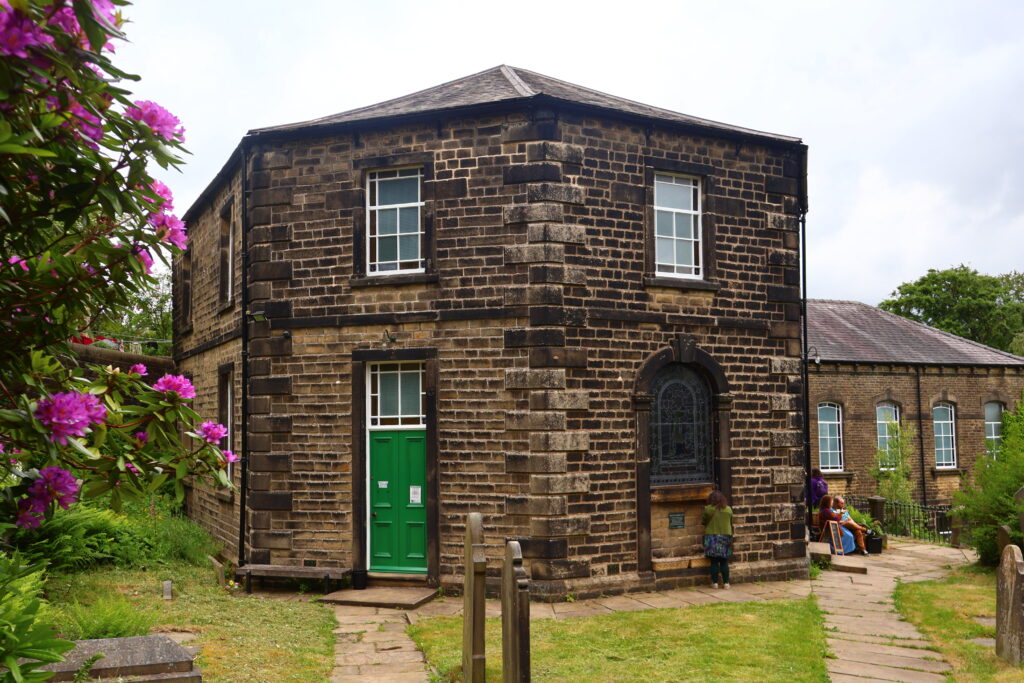
Octagonal Chapel, Heptonstall. Photo: Will Baldwin-Pask
It forgot its wild roots
Its earth-song
In cement and the drum-song of looms.
– Ted Hughes, “Hill-Stone Was Content” from Remains of Elmet
Put your ear to the cobblestones of Calderdale, West Yorkshire, and you might pick up the sounds that make this place. Psychedelic rumblings from The Golden Lion. Folky murmuring from The Trades. Dampened shouts from the Grayston Unity.
But listen closer, and you’ll catch something new coming from resonance, a collective based between Hebden Bridge and Todmorden, who intersect music, spirituality & local history with their roaming, deep listening events.
resonance is run by friends Matthew and Adam. Promoters and technicians by calling, they curate “happenings” that merge multiple artforms into something holistic, and hypnotic. “A bit soundbath-y, a bit performance-y,” they summarise. “Bit of this, bit of that.” This and that includes music from the ambient, folky end of things, provided by local and genre-leading artists or DJs – Mary Lattimore, Surgeon, Sybil, and Ruf Dug have all appeared at their nights – programmed alongside poetry, lectures, workshops, or anything else that compliments the art. Every event is in a different, usually religious setting, with crystal-refraction lighting added by collaborator Jamie House to give it a psychedelic, pagan tone.
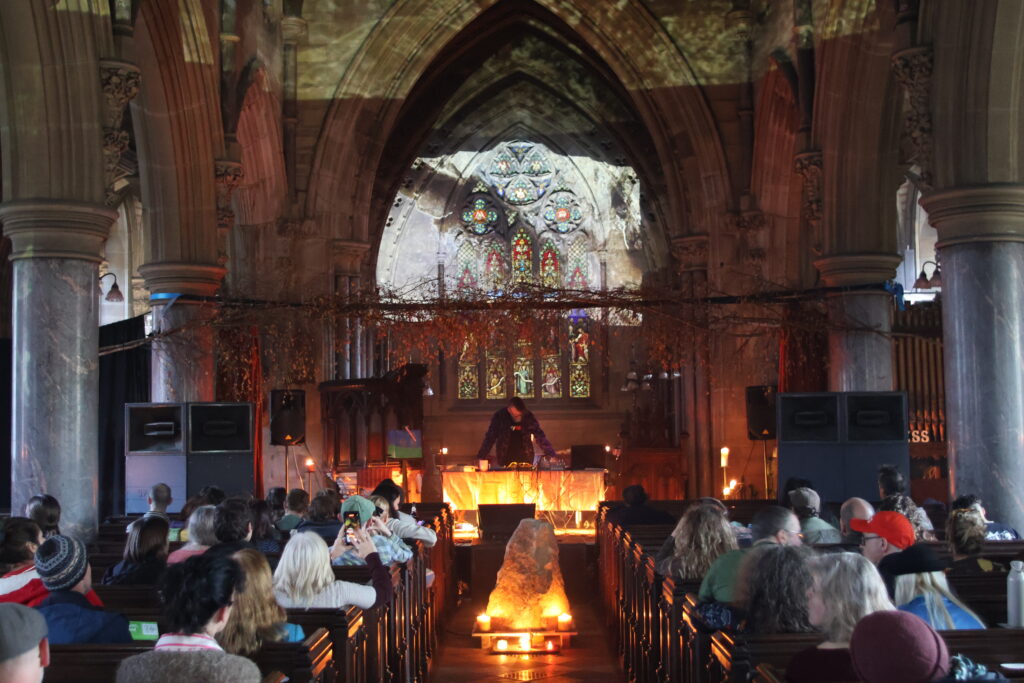
Spaceship Mark performing at Harmonicon, 2025. Photo: Adam Kahan
Their first event in Todmorden, January 2024, was headlined by local artist John Haycock, known for his transcendental kora compositions. This summer, they released John’s latest album ‘What Remains’, and celebrated with a night of performance at the world’s oldest Methodist chapel.
Ahead of the event, I meet Matthew and Adam at their place in Hebden. There’s tea, there’s incense, there’s free jazz and there’s an organic veg box delivery from the cooperative. Both have relocated here from London, seeking something that the capital can’t offer: something slower, something stranger, somewhere that creates space for something like resonance to succeed.
“You’re in this crucible here…” says Matthew, describing the township they now call home. “It’s a breeding ground for alternatives, for people to meet and try stuff.” Hebden Bridge and Calderdale have a long history of attracting non-conforming creative types, oversimplified by outsiders as ‘hippies’. But there’s practical reasons for this attraction. Whilst creatives in the hyper-gentrified London and Manchester have to compromise to make ends meet, the valley’s lower cost of living means people “can just about get away with writing and making music that doesn’t need to be commercially viable”, keeping its honest, uneven edges intact for an audience open to experimentation.
That explains the chord they are striking with locals. “Most of Todmorden showed up” to their first event. Last year’s town-wide festival, Harmonicon, drew over 200 people for a two-day programme of folk jams and live sound pieces. They recall attendees turning up with synths to spontaneously join in, or writing poems on day one to read to the audience by day three. Inspired by the event, one person even quit their job to move to India and become a sound practitioner. They’ll take over Todmorden’s Unitarian Church and gig venues again this year, as Harmonicon returns with interactive experiments and open sessions across town.
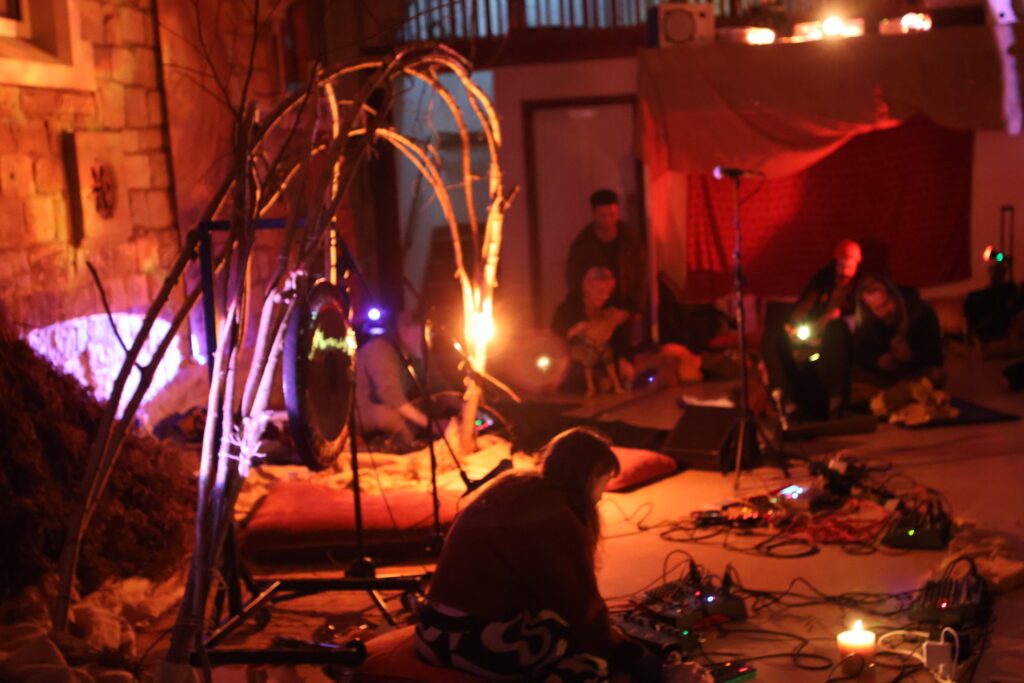
resonance event at Fielden Hall, Todmorden, Jan 2026. Photo: Adam Kahan
Adam and Matthew describe resonance as “an alternative voice that stands on a history of people being a bit outside”. Their rapid impact proves they’re a weird, welcome addition to Calderdale, consistent with venues like The Golden Lion that offer leftfield, inclusive experiences that are music-focused, and vibe-heavy.
But their roaming nature stands them apart, allowing them to tell a much bigger story about the valley and beyond. Wainsgate Chapel, Tod Unitarian, and even a crypt in Bristol have all been host to resonance. They treat each venue as a collaborator rather than a canvas. Artists are asked to perform work that reflects on the space. Lighting and design are crafted seamlessly within the setting. Those involved in the church or chapel give presentations on the stories around it.
“Everything is an opportunity to learn”, says Adam, even your local place of worship. These events are “giving homage to community spaces” that are purpose-built for attention & reflection. In an age when we despair endlessly over vanishing cultural spaces, making use of the churches that have been hiding in plain sight for years, is genius.
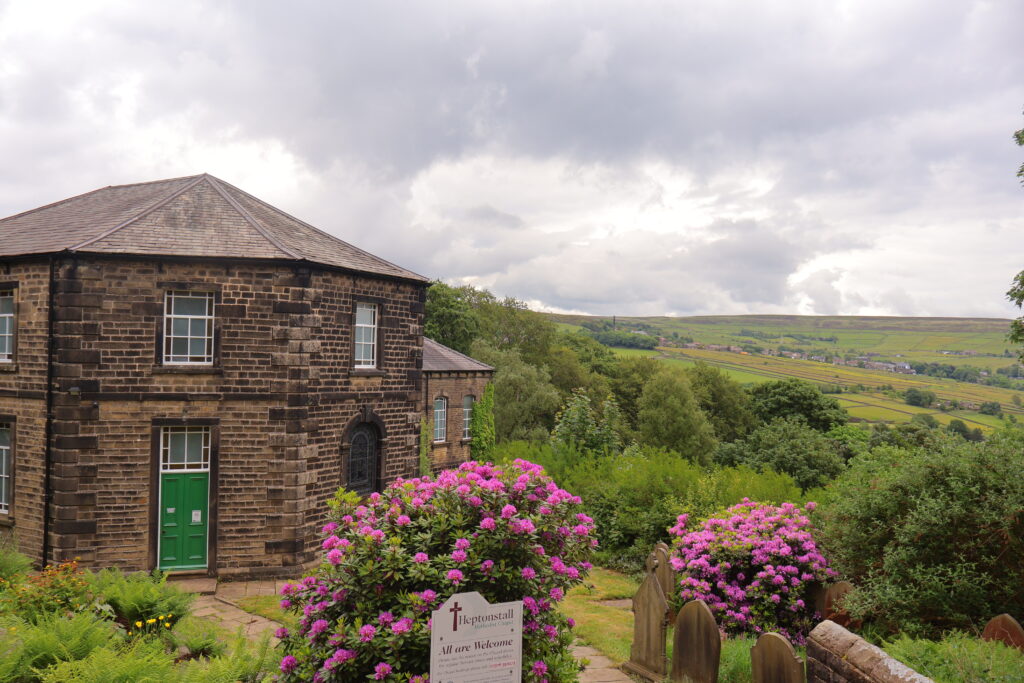
Octagonal Chapel. Photo: Will Baldwin-Pask
This summer, they head uphill to the village of Heptonstall, a thousand feet above sea level and a mile’s walk from Hebden, taking over its Octagonal Chapel for their event, ‘what remains’.
“We spent time in Heptonstall last year, and there’s some strong energy up there. The lifestyle is different…” says Adam. Heptonstall is the original Calderdale settlement: a 12th century village, once a Gaelic stronghold, hotly contested during the Civil War, and transformed during the industrial years. Locally-born poet Ted Hughes frames the ripping of sandstone from the earth to make the mills as the moment the valley started losing its soul. Sylvia Plath, writer and once-spouse of Hughes, is buried in the soil there.
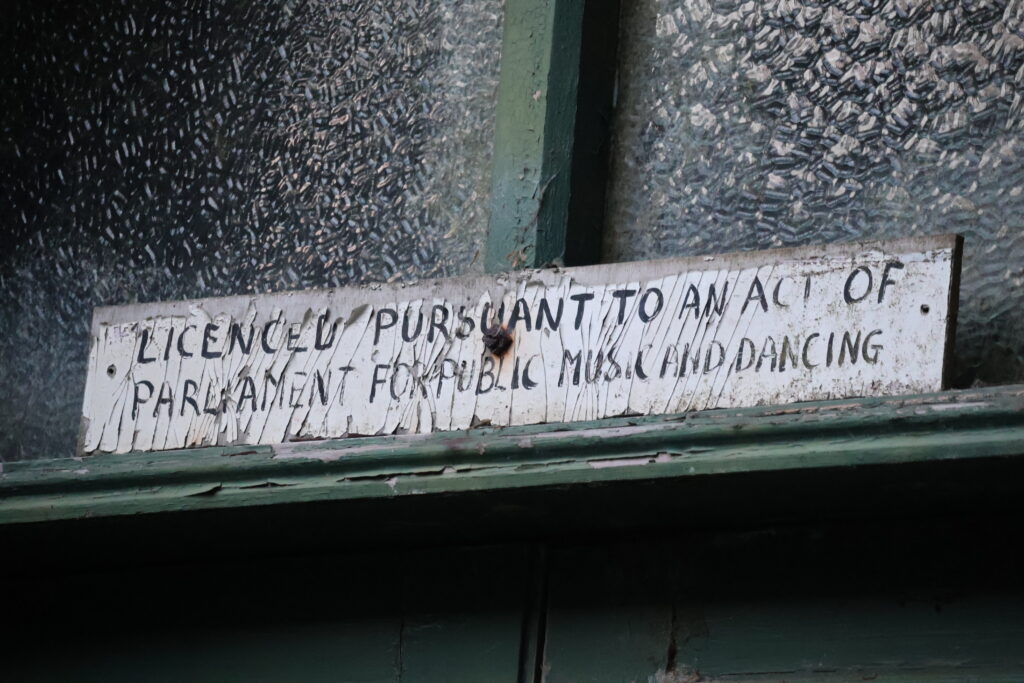
Octagonal Chapel. Photo: Will Baldwin-Pask
Nothing happens on the tops, as they say. Whilst towns like Tod and Hebden sit in the bowels of the valleys, harbouring noise, Heptonstall is your classic sleepy, cobbled village, with narrow roads, stunning views and an implicit curfew. The Chapel faces East over the meanders. Flowers hug gravestones; the building clings to the vivid hill as the wind slaps its eight walls. Inside, a crowd of stain-glassed windows surround a room warmed with burgundy wood. Before the event, everything is still.
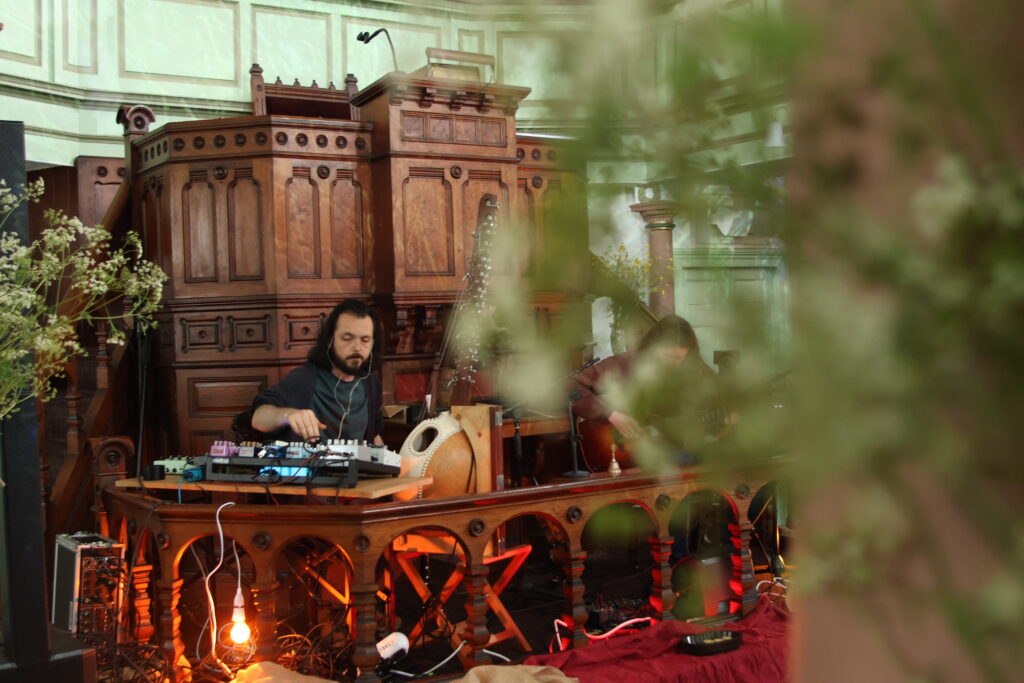
John Haycock (left) and Daniel Bridgwood-Hill (right) at Octagonal Chapel, Heptonstall. Photo: Adam Kahan
Both the night and John’s album take their title from Hughes’ poetry collection, Remains of Elmet, Elmet being the Celtic kingdom that covered the area known as West Yorkshire from the 5th to 7th Centuries. The shared titling mirrors what the resonance team intend to do in Heptonstall – connecting land to art, history to the present.
Music includes a looping, angelic vocal set from Laurel Morgan and her board of pedals, and Magpahi who marries moog synth with medieval singing. Interspersed are non-fiction talks, including an introduction to the Chapel’s history from its custodians on its founding and resolute role in the community for two centuries, a lecture by academic Jackie Anderson on Elmet’s history and how we relate to the land, before local historian Paul Weatherhead provides a lecture on the history of the valley: its horrors, witches, outlaws and UFO abductions. Then in between, there are breaks for the audiences to spill on to the Chapel lawn, chatting as dusk seeps into the landscape, processing the performances.
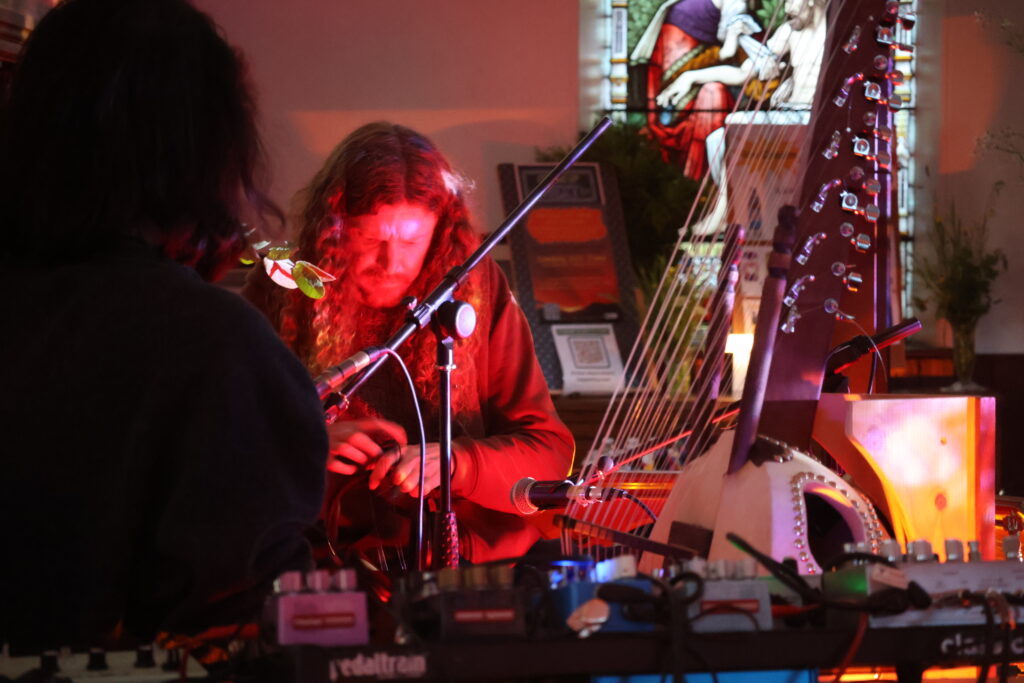
John Haycock (left) and Daniel Bridgwood-Hill (right) at Octagonal Chapel, Heptonstall. Photo: Will Baldwin-Pask
The final section features spoken word from Zaffar Kunial, performing his own pieces on migration and family loss, as well as a Hughes poem, before climaxing with the headline set from John Haycock. Performing electronics, kora, and clarinet, alongside Daniel Bridgwood-Hill on guitar and violin, John’s 40 minute album is played in full, unbroken, lightly placing layers around droning chords as projections of natural imagery bathe the walls.
Plucks, legatos, assonance and echoes, build to an overwhelming fragility. All the ideas that the evening has conjured, surface in a trance. The Easter congregants gathered in the Chapel. The mill workers, making this town. The witches and the outlaws. Lost families. Windfarms. John Wesley, a wandering UFO, and a sombre Ted Hughes. The history of Heptonstall and the spirit of Calderdale, brought to life for a dimly lit moment – the soul of a place, summoned through sound, hanging like smoke in the Chapel air.
And then it ends. There’s applause and there’s chatter. There’s a crowd filing out of a chapel on a hill. The local and the curious leave Heptonstall in cool silence; the congregants head home, just as they’ve always done, as the sound of Heptonstall rings in the ear.
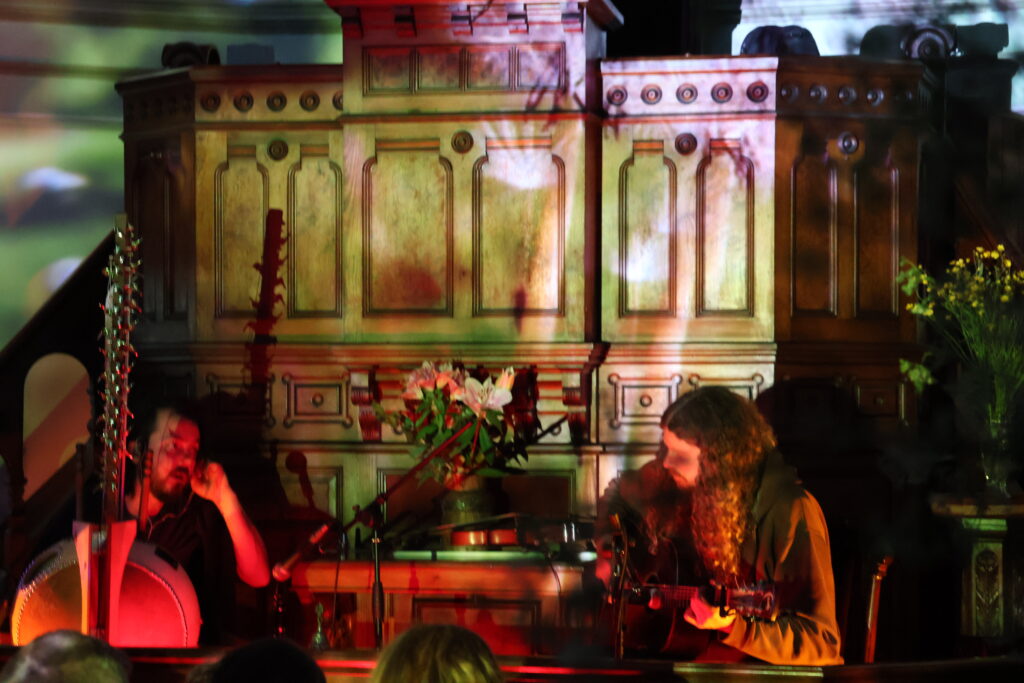
John Haycock (left) and Daniel Bridgwood-Hill (right) at Octagonal Chapel, Heptonstall. Photo: Will Baldwin-Pask
Over a hundred people joined throughout the five hours this evening. The team are already selling the upcoming Harmonicon well, and will continue to find new places to take over. There’s demand in the valley, for sure. But there’s potential for resonance to reach far beyond hippies and sound nerds in Calderdale. Events like these have at least one element that all sorts of people can latch on to – yet almost all of us in this secular, screen-based age could do with the chance for pause that it provides.
“It works on a somatic level,” says Matthew. “Being in a space is not just about being somewhere nice; it’s a real antidote to the atomisation of digital culture, and the way we have to consume art. You’re aware of where you are. What you’re listening to now. What you’re seeing in the refractions. You feel connected to something.”
“And using all these elements to make something harmonic,” adds Adam. “Historic buildings, stories, lighting, tonal frequencies… it’s not just harking back to the past, it’s about helping people today.”
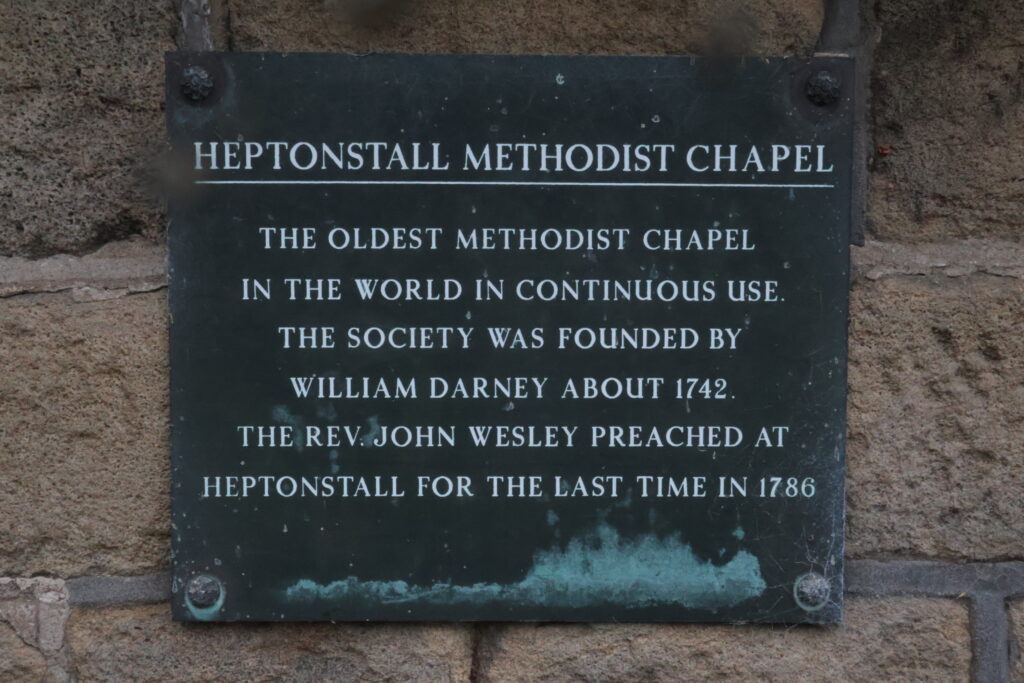
Octagonal Chapel. Photo: Will Baldwin-Pask
In culture, we talk a lot about ‘human connection.’ We tend think of this in terms of people in a room. Some artists manage to reach out and traverse timelines and cross valleys, linking their audience with unknown peoples, with unseen places, with unfelt pasts, or something deeper in the spirit or nature. They redefine human connection as something beyond the realm of a room, that resonates across generations and geographies.
Adam, Matthew, and all involved in resonance, understand this.
No place makes one sound continuously. Maybe Hughes saw the earth song of Calderdale give way to the noise of industry. But today, that song is revived by the resonance team, who have found in John, in the Chapel, in the valley and in its people, the sound of here and now.
***
resonance will host their second Harmonicon festival in Todmorden this October – follow them for updates and to book tickets now.
Filed under: Music
Tagged with: ambient, Calderdale, community, electronic music, folk, Hebden Bridge, history, John Haycock, medieval, resonance

Comments