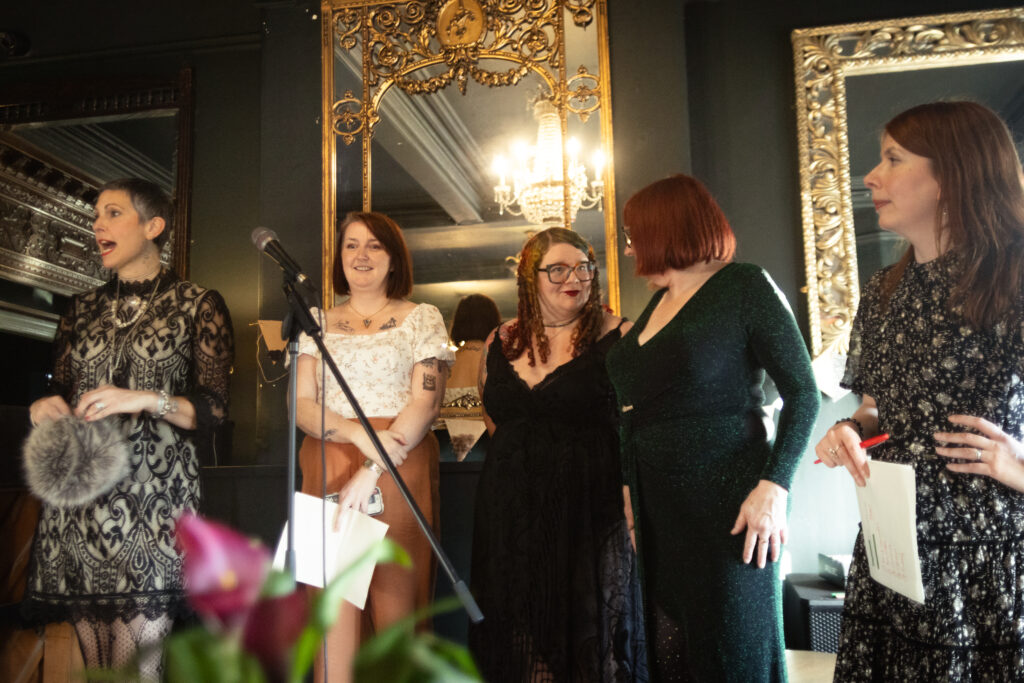
‘That’s What She Said’ Poetry Night. Image Credit: Natasha Dobson.
My first column for this publication went up on 12 June 2025, and urged people to support an upcoming event called ‘That’s What She Said’. It was the first poetry gig by an all-female collective to grow out of our grassroots spoken-word circuit, with the members wanting to provide a platform for themselves and other women who, like them, had suffered domestic abuse.
That the second gig did not happen for 15 months speaks to precisely the trauma they were speaking about. Since that first event, Sarah – aka the Worrier Queen – managed to finalise a divorce from the coercive controller to whom she had been married for over two decades. The battle, however, and the ensuing relief, took it out of her, and she took a long break from the circuit.
If anyone thought their message might have gone stale, or that they had lost their momentum, they were very wrong. This time, they got a bigger room at The Cardigan Arms (Katie-Lou Clarkson liked its “Great Gatsby vibes”) and filled it with themselves, some female open mic readers, an enthusiastic audience and some items for sale. Among them, a beautiful ‘That’s What She Said’ anthology, which York’s Forge Press took a chance on – and which sold like hot cakes. There were also hot cakes, of course. If there was a tinge of disappointment, it was that only three men came to support this important event. Those who stayed away missed the chance to be an ally, to take part in important conversations and to soak up a brilliant, sad, joyful and sometimes uproariously funny afternoon of poetry and discussion.
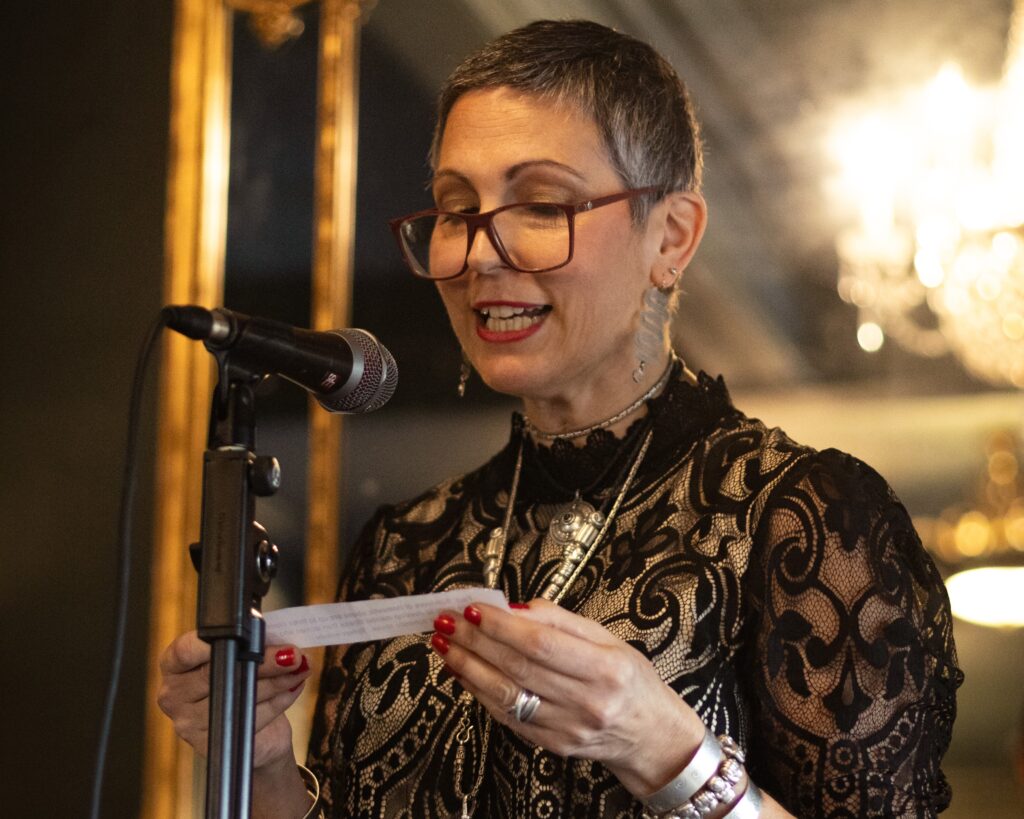
Sarah Rooke, aka The Worrier Queen. Image Credit Natasha Dobson.
The collective’s title is obviously a play on words, highlighting the importance of women’s voices being heard but also the smutty humour they love. When Sarah joined our community two years ago, she quickly developed a reputation for a Carry-On style sense of humour and a propensity to shout out “That’s What She Said” in response to anything which might be even tangentially interpreted as a double-entendre. Her and Katie-Lou were at it (that’s what she said) from the off when Katie-Lou’s welcome to all of us was “Thank you for coming”, to which Sarah added “yes, over and over again”. Katie-Lou took the opportunity to address the meagre collection of men in the room to say “you see, that’s how it should be, gentlemen, and always before you too, please”.
That said, the troupe has developed skilful ways of balancing the humour with the grim realities of existing as women in the world. In her poem ‘One in Four’, Molly Hope interrogates the statistic that one in four women experience rape or sexual abuse, recounting the abuse she had suffered at the hands of different men. Her account is interspersed with more grim facts, as she asks: “And is it really [only] one in four?”
Her set continues to explore these themes, layering abuse upon abuse as her voice is disregarded by abusers, bad lovers and a wider society that prioritises men over their victims. The set takes a more hopeful turn in ‘Women (that hold each other in car parks), in which Molly movingly takes us through the beginnings of her resistance journey. The poem was inspired by speaking with Sarah in the early days of their friendship, when Molly realised that she, too, was living with an abusive partner.
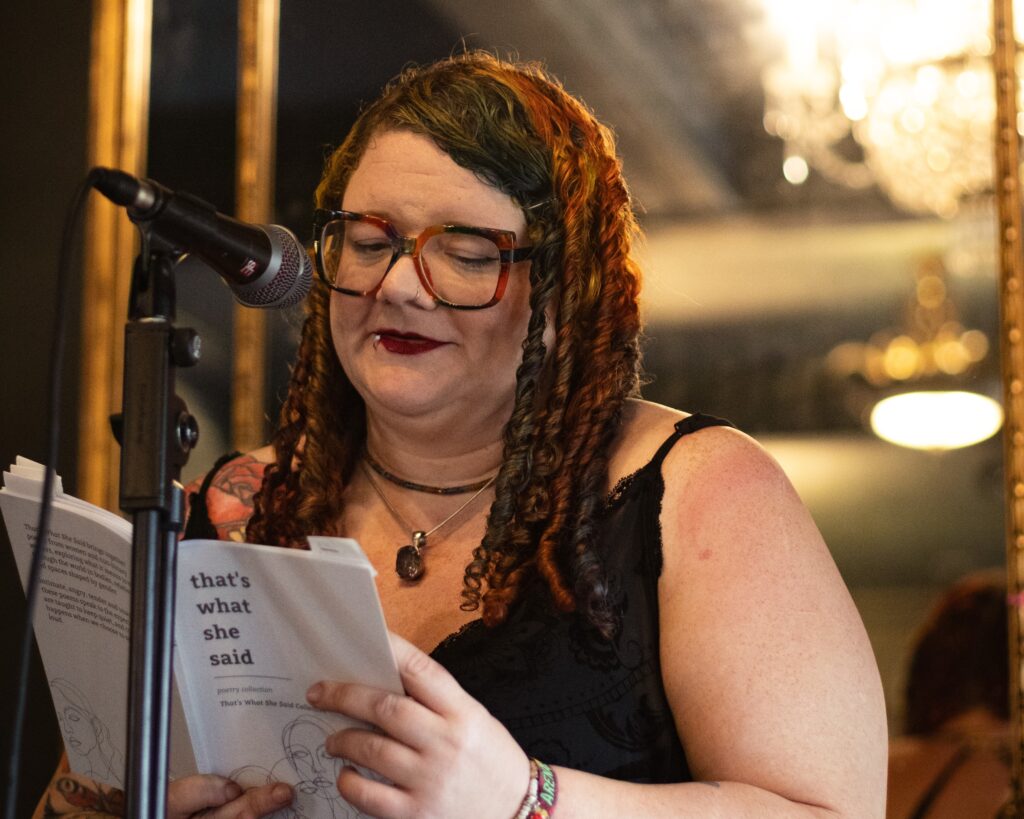
Molly Hope. Image Credit Natasha Dobson.
This poem is a fitting opener to the women’s brilliant Forge Press anthology, which crackles with their diverse characters throughout. Julie Baird – aka Radical Annie’s – triumphantly rude, lewd and defiant spoken-word pieces, like ‘Menopause Queen’ and ‘Prick Teaser’ ram a flagpole of unapologetic sexual independence spar with Sarah’s rage against the two men who controlled her life for 33 years. Sanah Akhtar’s ‘Chosen Family’ and ‘Mother’, lamenting the abuse she experienced and witnessed growing up, find bedfellows in Anne-Marie Draycott’s ‘Listless’ and ‘My Secret Love’ (herself!), quiet but powerful vignettes about not taking up too much space. Molly and Katie-Lou both expertly weave their heart-breaking stories of rejection, abuse and emotional neglect with facts and figures that place these individual experiences in a wider social context.
The anthology ends with a poem they all wrote together, ‘To be a Woman’, an expression of shared identity, a history of trauma, a blueprint for the future and a call to arms all rolled into one.
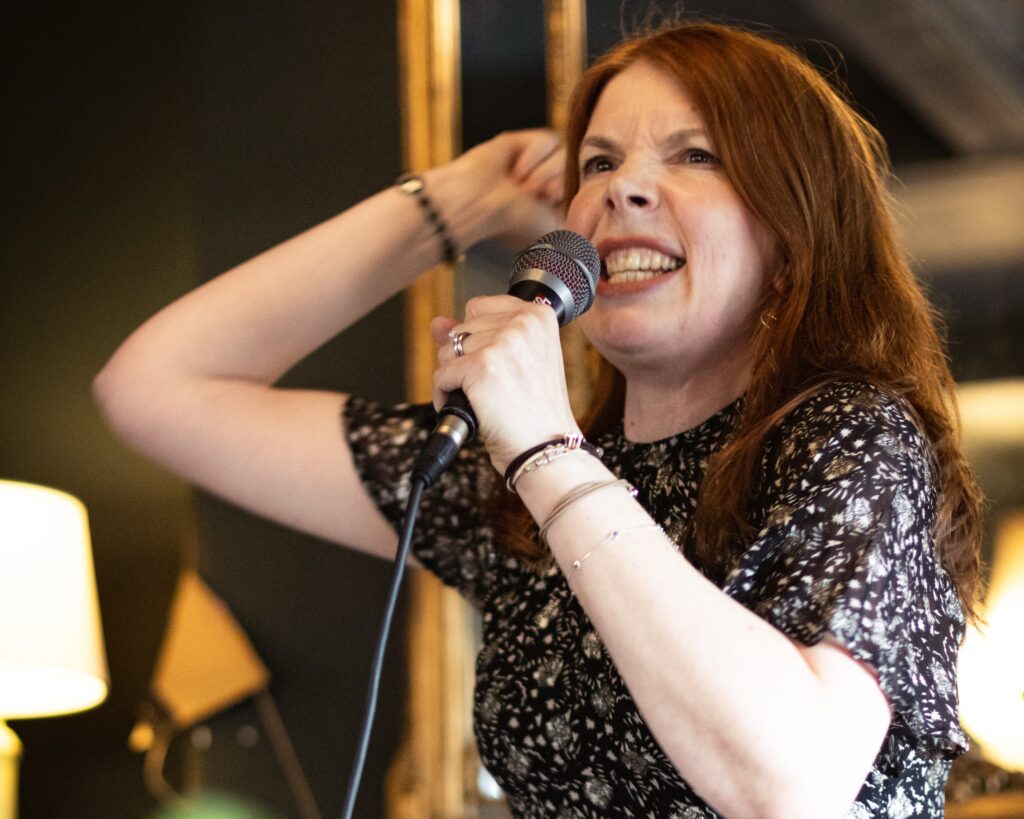
Anne-Marie Draycott. Image Credit: Natasha Dobson.
Unfortunately, the editor, typesetter and cover-designer from Forge Press, Dilan Şirin, could not be there to take the plaudits for their wonderful achievement in putting this volume together. It should not exist only to give voice to six poets who had been unheard for so long, nor only to raise money for the domestic abuse charity Refuge, but also to assure women they are not alone. I would prescribe this collection to the National Health Service if I had my way.
Sadly, there was another absentee, as Sanah had a family bereavement to attend to, but fittingly, the group stood on the stage together to communally read one of her poems. Sarah’s set included ‘Motherfucker’, ‘The Line’ and she introduced ‘Gaslit’. In between poems, she talked about a grim sex-life across two marriages, where she wondered how much of it could have been said to be consensual, a truly chilling thought. She also shared lessons she had learned, one of which she begged the audience to learn too – “listen carefully to other women”.
Radical Annie left much of her trauma unspoken, explaining she had not yet found ways to comfortably express a lot of it. She read a protest poem called ‘The Cut’ about the routine episiotomies which women were given in the 1980s when she became a mother, asking who gave permission for people to do that to her body. She is known too for her protest against the way parent-carers like her are treated by the government and society, highlighting the intersection of disability, medical treatment, neurodivergence and shame. She ended her set with an emotional and sisterly tribute to the Fenswomen friends of her youth.
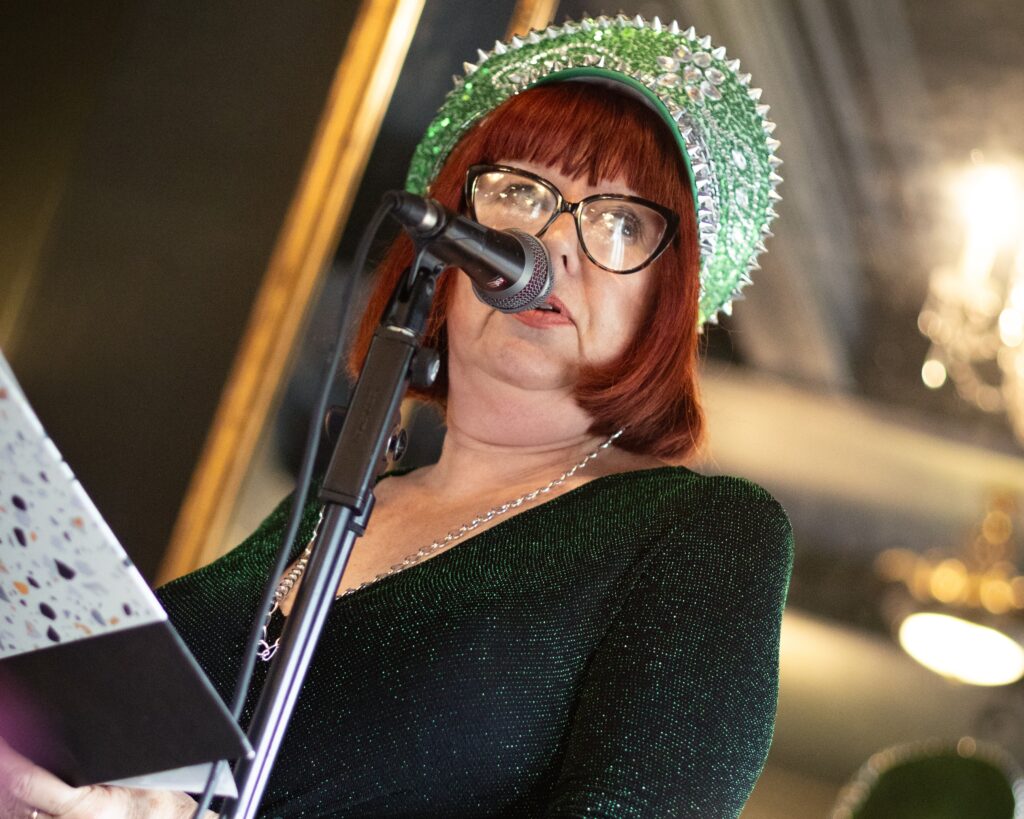
Julie Baird, aka Radical Annie. Image Credit: Natasha Dobson.
Anne-Marie Draycott navigated a childhood surrounded by domestic violence by keeping her head down and “not causing any fuss”. Since then, a fire has stirred in her and she now works as a facilitator trying to help women express themselves through creativity. In ‘The Good Girl’, she reflects on the frightened child she once was: “unknowingly she trades / tiny pieces of herself / for a precarious safety”, while showing defiance can be playful and fun in ‘Lutey and the Mermaid’, the name of a band she wants to be in before she decides she wants to be the lead singer Lutey herself.
Since I first heard Katie-Lou Clarkson’s poetry a couple of years ago, she has gotten better and better. Now she is an accomplished performer and slammer. She performed ‘Stoning’, a measured yet devastating take-down of patriarchal attitudes to sexual violence, at the I Am Loud slam in Bradford, where she (and Molly) beat some excellent performers to get to the penultimate round. In the collection, her ‘What Love is Not’ appears directly after Molly’s ‘What is Love?’, as if it were a direct response. She tells us it is not “conditional”, “controlling”, “compromising” or “hurtful”, conceding she “might not know what love is / but I know for certain / what love is not”.
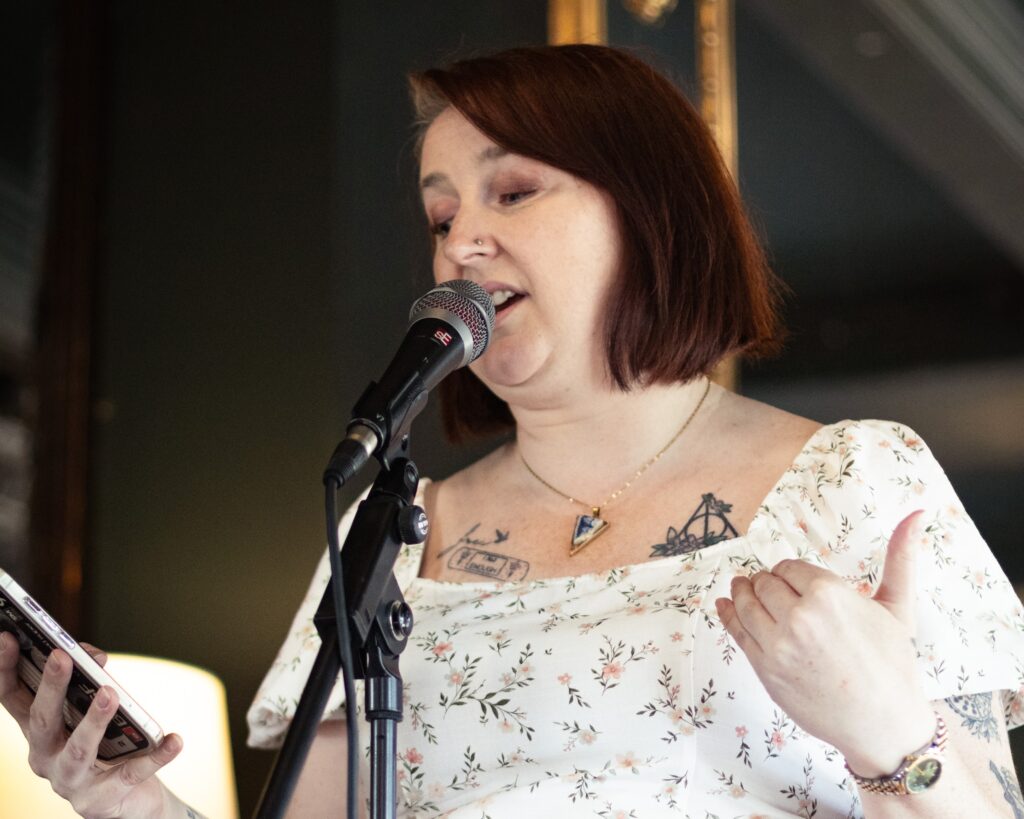
Katie-Lou Clarkson. Image Credit: Natasha Dobson.
The crowd’s rapturous ovation should show Katie-Lou and the other women what love can look like: a community coming together to lift up not only its own members, but others in the community too, encouraging women to speak out unconditionally and uncompromisingly. And if any men out there feel excluded from this process, they could still buy the book, and next time, come along and listen!
***
‘That’s What She Said’ anthology features poems from Molly Hope, Sarah Rooke aka The Worrier Queen, Sanah Akhtar, Anne-Marie Draycott, Julie Baird aka Radical Annie and Katie-Lou Clarkson. You can purchase it from Forge Press.
Filed under: Community, Poetry, Written & Spoken Word
Tagged with: Cardigan Arms, domestic abuse, Forge Press, poetry, refuge, spoken word, That's What She Said, women
Comments